What Size Dehumidifier Do I Need UK? The Ultimate Capacity Guide
Waking up to weeping windows and battling indoor laundry are staples of the British winter. Most people buy a dehumidifier based purely on its physical footprint. They want a small box that hides in the corner.
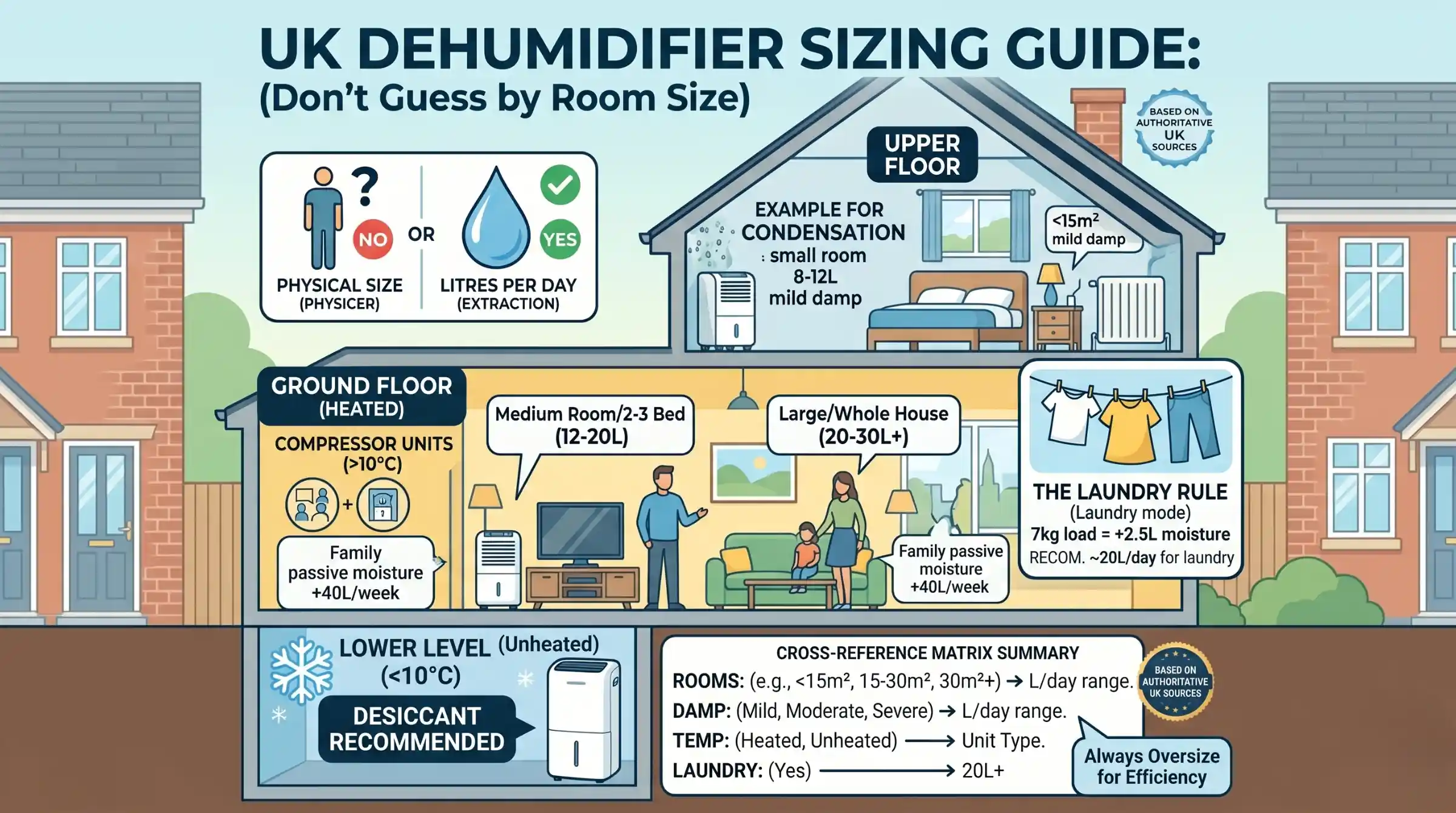
That is a costly mistake. True “size” is actually all about daily moisture extraction. We measure this in litres per day (L/day).
Choosing the correct extraction rate is vital. You must balance it with the right tank capacity and temperature rating for your home. Get this wrong, and you waste money on a noisy box that does nothing to cure your damp problem.
To determine what size dehumidifier you need in the UK, look at the extraction rate. For a small room (up to 15m²) with mild condensation, an 8L to 10L per day unit is sufficient. Medium rooms (15-30m²) require 12L to 20L, while whole-house extraction needs a 20L to 30L+ capacity.
Key Takeaways
- “Size” refers to Litres per day (L/day) extraction capability, not physical dimensions.
- Your home’s ambient temperature dictates whether you need a compressor or desiccant model.
- Indoor laundry drastically increases your required daily extraction rate.
- Internal tank capacity must match your daily routine so the machine does not stop working while you are out.
- Oversizing your unit is far more energy-efficient than buying a smaller, cheaper model.
Quick Start: The “What Size Do I Need?” Decision Tree
Need an answer right now? Follow these steps.
- Step 1: What is the temperature of the room in winter?
- Below 10°C (like a garage or conservatory): Stop here. You need a Desiccant dehumidifier. An 8L to 10L capacity is standard.
- Above 10°C (a standard heated home): Proceed to Step 2.
- Step 2: What is the primary problem?
- Mild window condensation in 1-2 rooms: Choose an 8L to 12L unit.
- Drying laundry indoors or moderate damp: Choose a 12L to 20L unit.
- Severe whole-house damp in a large 4-bed home: Choose a 20L to 30L+ unit.
Pro Tip: Use a Hygrometer First. Before deciding on a massive 25L/day unit, test your room with a cheap digital hygrometer. If your relative humidity sits consistently between 40% and 60%, you may not actually need a dehumidifier at all.
Understanding Dehumidifier Sizing (It’s Not Just About Dimensions)
When manufacturers talk about size, they mean the moisture extraction rate. This is how many litres of water the machine can pull from the air in 24 hours under ideal test conditions.
Common Mistake: Confusing the extraction rate with the physical water tank capacity. A unit might be advertised as a “20L dehumidifier.” That means it extracts 20 litres a day. It does not mean it holds 20 litres of water. The actual internal tank is usually much smaller, often just 2 to 5 litres.
If the tank fills up, the machine switches off. This brings us to a major buying factor.
Tool: The Tank Emptying Frequency Calculator
Divide your expected daily extraction by the actual tank capacity. This tells you how many times you must manually empty it each day.
- Bad Match: 20L extraction / 2L tank = You must empty it 10 times a day in extreme damp.
- Good Match: 20L extraction / 5L tank = You empty it 4 times a manageable day.
Pro Tip: Check the Tank to Extraction Ratio. Match your tank size to your availability. If you are at work all day, buy a unit with a larger tank. Alternatively, ensure the model features a continuous drainage hose so it can empty straight into a sink or drain. You can check how different appliance running times impact your bills using Ofgem energy advice.
What Size Dehumidifier Do I Need for UK Room Sizes?
Square meterage gives us a solid baseline. Here is a breakdown of what you need based on the size of your space and the severity of the damp.
| Room Size (UK Equivalent) | Damp Severity | Recommended L/day | Best Technology |
| Up to 15m² (Single bedroom) | Mild to Moderate | 8L – 12L | Compressor |
| 15m² – 30m² (2-3 bed house) | Moderate to Severe | 12L – 20L | Compressor |
| 30m² – 50m²+ (Large house) | Severe whole-house | 20L – 30L+ | Compressor |
| Any size | Unheated (<10°C) | 8L – 10L | Desiccant |
Small Rooms and Single Bedrooms (up to 15m²)
For a single, confined space, an extraction rate of 8L to 10L per day is typically enough. This handles mild window condensation perfectly.
Real Example: A user living in a standard 1-bedroom UK flat experiencing morning window condensation generally resolves the issue effectively with a 10L to 12L per day compressor dehumidifier.
Medium Rooms and 2-3 Bed Houses (15-30m²)
Most standard UK homes fall into this bracket. If you have moderate damp spreading across multiple rooms, step up your capacity. You generally require a unit with a 12L to 20L extraction rate. This provides enough power to pull moisture from adjacent hallways and open doors.
Large Homes and Whole-House Extraction (30-50m²+)
Managing moisture across a four-bedroom house or a property suffering from severe structural damp is a heavy-duty job. A large house setup requires a high-capacity model extracting 20L to 30L+ per day.
Pro Tip: Central Placement. For whole-house extraction, do not lock the machine in a spare room. Place a 20L+ unit at the bottom of the stairs or in a central hallway. Leave internal doors open. The machine will draw moisture from the entire property.
The Hidden Variables: Laundry, Humans, and UK Winters
Room size is just the starting point. Three hidden variables impact your actual moisture load daily. Ignore these, and your machine will fail to keep up.
- The water weight of your laundry: Wet clothes release litres of water directly into your air.
- Passive human moisture: Breathing and sweating generate surprising amounts of damp.
- Ambient room temperature: Cold air changes how internal extraction mechanics work.
NHS guidance on indoor damp highlights how excess indoor moisture directly causes mould, increasing the risk of respiratory infections. You must factor your lifestyle into your sizing decision.
The Laundry Water Weight Rule
Drying clothes indoors is a massive challenge in the UK. A typical 7kg load of wet laundry contains roughly 2 to 2.5 litres of water. To dry this effectively in six hours without saturating your bedroom, you mathematically must have an extraction rate capable of pulling at least that volume in that specific timeframe. A small 10L/day unit is simply too weak for heavy laundry days.
Typical scenario example: A household of four relies on indoor drying during UK winters. This results in severe bedroom condensation. Upgrading from a basic 10L/day unit to a 20L/day model with a ‘laundry mode’ reduces drying time from 24 hours to just 6 hours. It eliminates the associated window condensation entirely.
Real Example: A 4-bedroom house drying multiple loads of washing indoors typically requires a 20L to 25L per day unit with a dedicated laundry mode. This clears the 15 to 20 litres of weekly moisture generated by the wet clothes.
Pro Tip: Look for ‘Laundry Mode’. If you are buying a unit to replace a tumble dryer, ensure the model has a dedicated laundry setting. This forces the fan to maximum speed and lowers the target humidity specifically for wet clothes.
Human Occupancy (The Breathing Factor)
You generate water simply by existing. Everyday household activities like showering, cooking, and washing introduce huge amounts of damp into the air. A family of four can passively add 30 to 40 litres of moisture to their home every week just through breathing and occupying the space. Factor in the humans. Size up your machine if your home is fully occupied all day.
Compressor vs. Desiccant: The Temperature Trap
Compressor models are excellent for heated homes. But they hate the cold. If a room drops below 10°C, a high-capacity compressor model will spend all its energy defrosting its own coils. It will extract almost nothing. Desiccant models do not use cooling coils. They absorb moisture using a chemical wheel, making them perfect for freezing UK spaces.
Typical scenario example: A Victorian terrace owner places a massive 20L compressor dehumidifier in their cellar to combat damp. It extracts almost no water because the room is a chilly 8°C. Swapping to an 8L desiccant model results in rapid moisture extraction.
Real Example: A homeowner protecting tools in a cold, unheated UK garage requires a desiccant model, usually 8L to 10L capacity. Compressor models simply fail below 10°C.
Key Checkpoint Summary:
- Heated living spaces above 10°C need a Compressor unit (10L to 30L).
- Unheated spaces below 10°C need a Desiccant unit (8L to 10L).
- Heavy indoor laundry or large families mean you need a 20L+ capacity.
Running Costs & Why You Should Always Oversize
Buying a smaller unit to save money is a false economy. Smaller machines must run 24 hours a day just to keep up. That drives up your energy bill.
Pro Tip: Always Oversize. Buy a unit with a slightly higher L/day extraction rate than you think you need. It reaches the target humidity faster and switches off automatically. This saves you money on electricity compared to a smaller unit running non-stop.
Industry experts agree on this approach. “It is always better to oversize than undersize,” advises testing from Ideal Home (2024). This is especially true if you buy the appliance to tackle actual damp problems.
“In a perfect world, run the dehumidifier in your ‘laundry room’ often enough so that the relative humidity in there never goes above 50%rh,” suggests Chris Michael from Meaco.
You also need to think about the noise. “If you’re sensitive to noise, you’ll want to choose a dehumidifier that is quiet… be sure to check the decibel rating before you buy,” notes Rob Nezard.
Pro Tip: Calculate the Running Cost. Check the wattage of the machine before buying. Based on typical tariffs, most domestic units cost between 4p and 12p an hour to run. Multiply the kilowatt (kW) rating by your current energy tariff. This prevents nasty bill shocks. Which? guide to energy efficient appliances can help you compare running costs fairly.
Conclusion & Next Steps
Selecting the right UK dehumidifier requires balancing room size, average temperature, and your specific moisture challenges like indoor laundry. Sizing your machine purely by its physical dimensions is a recipe for persistent mould and high energy bills. Investing in the correct extraction rate up front prevents long-term structural damp and saves you money.
Next steps:
- Measure your problem room size and check the average winter temperatures.
- Buy a cheap digital hygrometer to test your current humidity levels.
- Calculate your required extraction rate and match it to a unit with an appropriate internal tank capacity.
Frequently Asked Questions (UK Specific)
What size dehumidifier do I need for a 3-bed semi-detached house?
For a standard 3-bed semi with moderate damp, a 12L to 20L per day compressor unit placed centrally will handle the load effectively.
Is a 10L or 20L dehumidifier better for drying clothes?
A 20L unit is vastly superior. It has the raw extraction power to pull the 2.5+ litres of water out of the wet clothes rapidly before the damp settles into your walls.
How much does a 20L dehumidifier cost to run in the UK?
Depending on the exact wattage and your current energy tariff, a typical 20L unit costs around 4p to 12p per hour to run.
Do I need a dehumidifier in every room?
No. If you leave internal doors open, a powerful 20L to 30L unit placed centrally in a hallway or landing can draw moisture from the entire floor.
What size dehumidifier do I need for a cold garage?
You need an 8L to 10L desiccant dehumidifier. Compressor models freeze and stop extracting water efficiently in unheated spaces below 10°C.
Is a bigger dehumidifier always better?
Generally, yes. Oversizing means the machine hits its target humidity quickly and turns off, saving energy and reducing mechanical wear and tear.
How quickly will a dehumidifier clear condensation?
A correctly sized unit should clear visible window condensation in a single standard bedroom within 2 to 4 hours of operation.
About the Author