How Long Does Typhoid Vaccine Last? The Complete UK Travel Guide
Many travellers assume an old travel jab covers them for life. It rarely does. When planning a trip to high-risk regions like South Asia or parts of Africa, an expired typhoid vaccine becomes a serious hidden risk. You need to know exactly how long your immunity lasts before you fly. This guide explains the official UK immunisation timelines so you can travel fully protected.
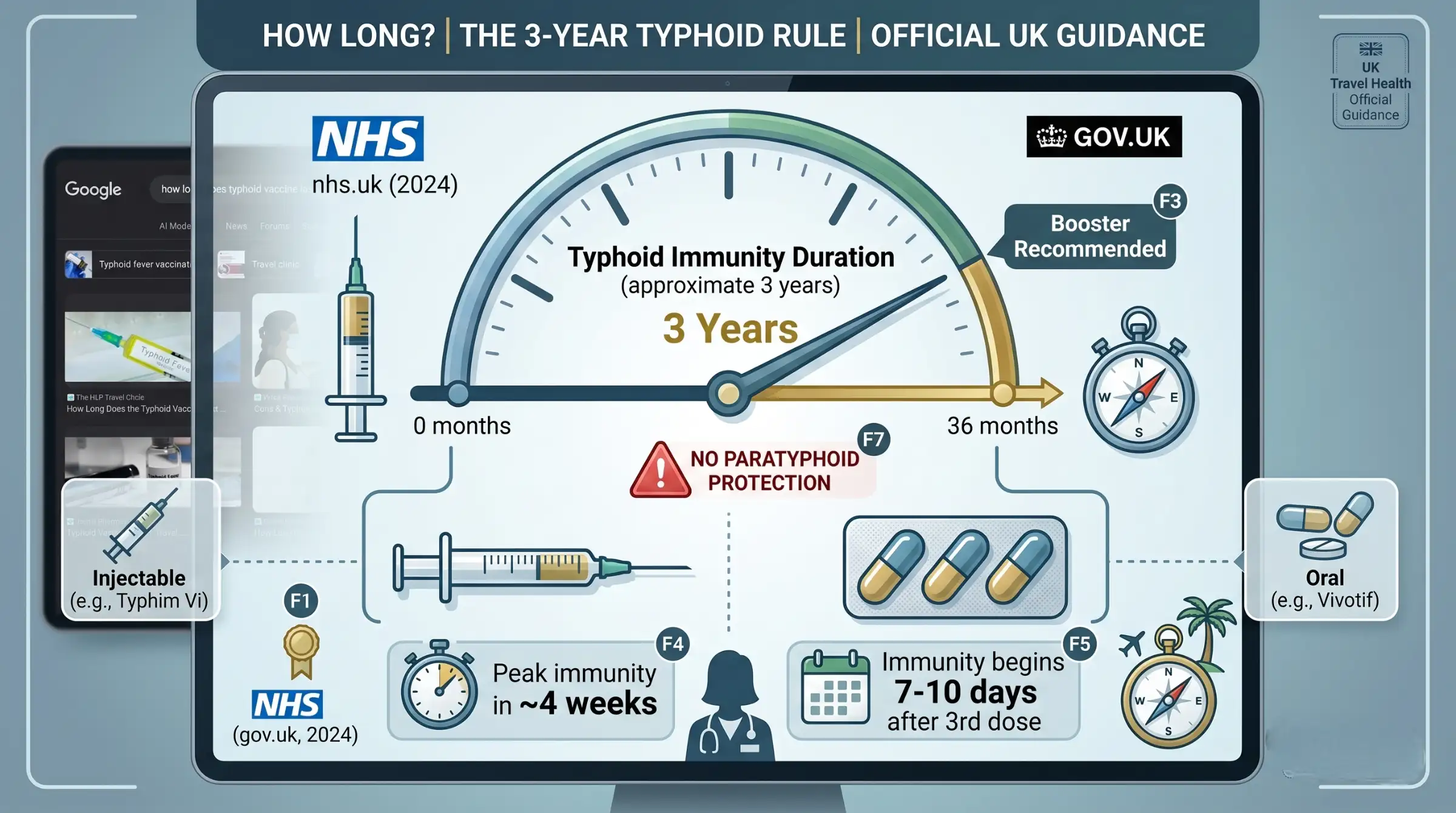
Both the injectable and oral typhoid vaccines provide protection for approximately three years for UK travellers. The injectable vaccine takes up to four weeks to reach maximum immunity, while the oral capsules provide protection 7 to 10 days after completing the final dose. Boosters are required every three years.
Key Takeaways
- Protection from both UK typhoid vaccines lasts roughly three years.
- Injectable vaccines need up to four weeks to hit peak immunity.
- Oral capsules must be completed at least 10 days before travel.
- Neither vaccine provides protection against paratyphoid fever.
- Perfect food and water hygiene remains essential regardless of vaccination status.
- Children under five can only receive the injectable version.
Quick Start: Pre-Travel Timeline Checklist
Need a quick action plan? Follow this schedule.
- T-Minus 6 Weeks: Audit your existing vaccination records. Confirm the exact administration dates.
- T-Minus 4 Weeks: Get the injectable vaccine to allow time for maximum immunity to build.
- T-Minus 2 Weeks: If taking the oral vaccine, ensure you finish the three-capsule course. Protection begins 7 to 10 days after the final dose.
The Official Timeline: How Long Does the Typhoid Vaccine Last?
The UK offers two primary forms of the typhoid vaccine. You can get a single intramuscular injection or a live oral vaccine taken as three capsules.
Both forms defend against the Salmonella Typhi bacteria. But their administration and timelines differ slightly.
Injectable vs. Oral Vaccines: A Clinical Comparison
| Feature | Injectable (Typhim Vi) | Oral (Vivotif) |
| Duration of Protection | ~3 Years | ~3 Years (UK Guidelines) |
| Time to Maximum Immunity | Up to 4 weeks | 7-10 days after 3rd dose |
| Minimum Age | 2 Years (Off-label from 12m) | 5 Years |
| Administration | Single Intramuscular Jab | 3 Capsules |
Here is a pro tip from the travel clinic. For children under five, the injectable is the only standard option. The oral capsules are strictly licensed for those aged five and older.
You can verify these specific eligibility criteria through official NHS guidelines on travel vaccinations.
3 Critical Rules Every UK Traveller Must Know
Do not just count years. Vaccine effectiveness relies on specific protocols. Keep these three rules in mind before booking your flight.
- The 3-Year Booster Mandate
Antibodies decline over time. “Booster vaccinations are officially recommended every three years for individuals who continue to be at risk” of typhoid infection due to travel. If your last jab was 3.5 years ago, you are no longer considered protected.
- The Paratyphoid Blind Spot
Common mistake: Thinking a typhoid jab covers all similar stomach bugs. It does not. The typhoid vaccine offers no protection against paratyphoid. This is a clinically similar bacterial illness for which there is currently no available vaccine. If you travel to endemic zones, paratyphoid is a major threat.
- The 100% Myth (Food & Water Hygiene)
Vaccines are a shield, not a forcefield. “Neither vaccine offers 100 per cent protection” against typhoid fever. Therefore, “scrupulous personal, food, and water hygiene remains essential” when travelling. Relying purely on the jab while drinking unsealed tap water is a fast track to severe illness.
Mid-Article Summary
- The 3-Year Rule: Both injectable and oral typhoid vaccines expire after approximately 36 months.
- The Waiting Game: Injectable immunity peaks at four weeks; oral immunity begins roughly 10 days after the final capsule.
- The Hygiene Factor: The jab is not a substitute for strict food and water safety.
Do I Need a Typhoid Booster?
Figuring out your vaccination status should be simple. Use this quick self-test to see if you need to book a clinic appointment.
- Did you receive the injectable vaccine more than 3 years ago? If yes, you need a booster. Your antibody levels have likely dropped.
- Are you travelling to a high-risk region like Pakistan, Bangladesh, or parts of Africa? If yes, you must review your water hygiene protocols immediately, regardless of your vaccine status.
- Are you also due for a Hepatitis A booster? If yes, request the combined dual-protection injection.
Here is a pro tip. If you cannot remember your last vaccination date or find your records, assume you are unprotected. Consult a travel clinic immediately. Never guess your immunity status. You can check the specific risk level of your destination using the UK Health Security Agency high-risk destination map.
The Combined Hepatitis A and Typhoid Jab
Many destinations require protection against multiple diseases. A combined injection offering dual protection against both Hepatitis A and typhoid is available. This is ideal for travellers who require immunity against both.
Take a typical backpacker heading for a multi-country tour through Southeast Asia. They need both Hepatitis A and typhoid cover. By opting for the combined injection, they minimise clinic appointments and save money. They just mark their calendar for a three-year booster review.
The “Clinical vs. Travel Reality” Gap
A clinically valid vaccine is not a free pass to ignore local conditions. Most cases of typhoid diagnosed in the UK occur in travellers returning from high-risk regions. These notably include Pakistan, Bangladesh, India, and parts of Africa.
Consider a typical scenario. A UK resident travels to visit family in Hyderabad, Sindh. They received the injectable vaccine two and a half years ago. They are still technically covered under the three-year clinical window. However, the extreme endemic risk requires them to strictly review water sanitation protocols. Why? Because of the lack of paratyphoid coverage and the fact that the typhoid jab is never 100 per cent effective.
Always keep a digital photograph of your travel vaccination card backed up on your phone. Local clinics often struggle to verify historical dates if you previously used a private pharmacy. Having the photo saves massive headaches at the border or the clinic.
End Summary
Do not leave your travel health to chance. The typhoid vaccine—whether oral or injectable—lasts for roughly three years. Planning ahead is vital because the injectable jab needs up to four weeks to hit peak effectiveness. Relying on an expired vaccine in an endemic region is a massive risk to your health and your holiday.
Next Steps
- Audit your medical records to find the exact date of your last typhoid jab.
- Book a travel clinic appointment at least four weeks before your departure date.
- Review the specific food and water risks for your exact destination, keeping paratyphoid in mind.
FAQs
Can you get the typhoid vaccine on the NHS?
Yes, the typhoid vaccine is currently one of the few travel vaccinations available free of charge on the NHS for UK residents, provided you are travelling to an area where the disease is present.
How often do you need a typhoid booster in the UK?
UK guidelines recommend a booster every three years if you continue to travel to regions where typhoid is endemic.
Does the typhoid vaccine protect against paratyphoid?
No. The typhoid vaccine offers exactly zero protection against paratyphoid. Paratyphoid is a clinically similar bacterial illness, and there is currently no vaccine available for it.
Can children under 2 get the typhoid vaccine?
Generally, children under one year are not recommended to receive the vaccine. However, children aged between 12 months and 2 years may receive the injectable vaccine off-label if a doctor assesses their risk as exceptionally high.
What happens if I lose my travel vaccination card?
If you lose your card and your GP or local clinic cannot locate your records on the NHS system, clinicians will usually treat you as unvaccinated. They will likely recommend a booster to be safe.
Can I take the oral typhoid vaccine if I am on antibiotics?
No. If you are taking oral antibiotics, notify your pharmacist immediately. Antibiotics can kill the live bacteria in the oral vaccine, rendering it completely ineffective.
How long before my holiday should I get the typhoid jab?
You should aim to get the injectable vaccine four weeks before travel. The oral vaccine must be completed at least 10 days before you fly.
About the Author