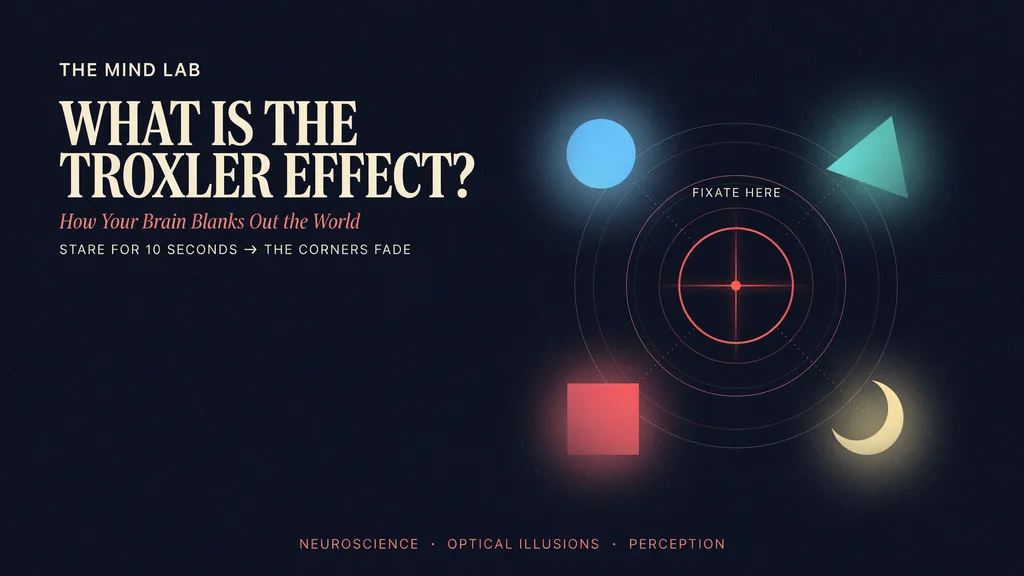
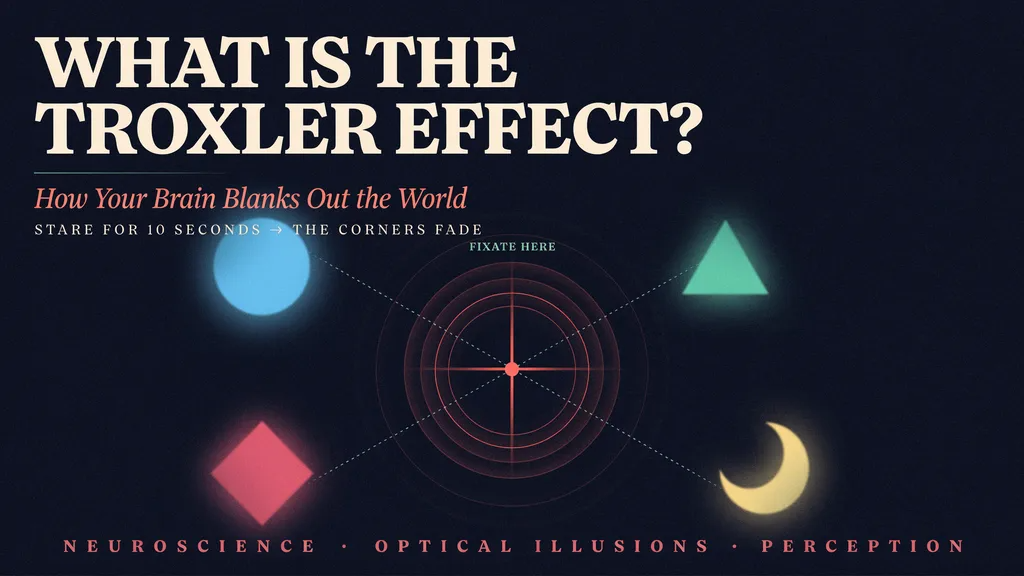
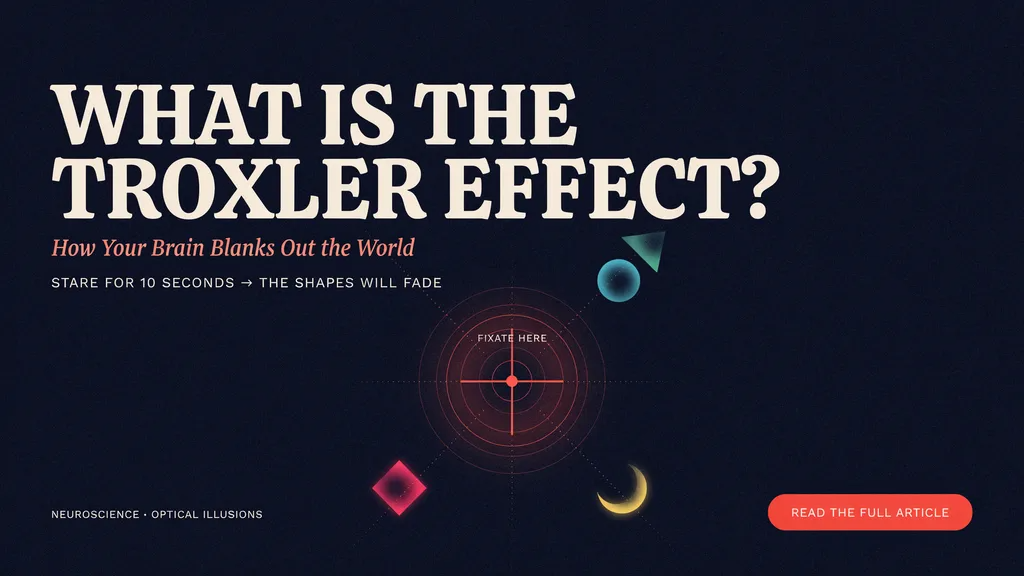
Have you ever stared at a fixed point for a few seconds and noticed that things around you start to vanish? This strange trick of the mind is known as the Troxler Effect, or Troxler’s fading. It is a cool optical illusion that happens right inside your head. When your eyes stay completely still, your brain decides to ignore boring, unchanging parts of your view. It is a fun way to test how your eyes and brain work together every single day.
A Quick Look at the Troxler Effect
| Feature | Details |
| Main Name | Troxler Effect (Troxler’s Fading) |
| Discovered By | Ignaz Paul Vital Troxler (in 1804) |
| Type | Visual Perception Illusion / Sensory Adaptation |
| Main Cause | Neural Adaptation & Stopped Microsaccades |
| Best Seen In | Peripheral Vision (Side Vision) |
Who Discovered This Fading Trick?
The man behind this discovery was a Swiss physician named Ignaz Paul Vital Troxler. Back in 1804, he noticed that if people kept their eyes locked on one spot, images sitting in their side vision would slowly blur and disappear. He realized that our visual system is built to chase movement, not stillness. His early work gave scientists a brand new window into understanding human sight and how we process light and color.
How Neural Adaptation Fools Your Mind
Neural adaptation is the big fancy scientific term for getting used to things. Think about putting a wristwatch on in the morning. At first, you feel it on your skin. After a few minutes, you completely forget it is there. Your touch nerves get tired of sending the same old message. The exact same thing happens in your eyes. When visual stimuli stay totally still, your brain cells stop firing off alerts, making the object fade away into nothingness.
The Secret Power of Microsaccades
You might wonder why the world does not constantly disappear every time you try to read a book. The secret lies in tiny movements called microsaccades. Even when you think your eyes are locked tightly in place, they are actually making microscopic shakes and flicks. These tiny jumps force light to hit fresh spots on your retina. By constantly refreshing the signal, your eyes keep the picture alive and stop the fade from happening under normal conditions.
Why Peripheral Vision Fades the Fastest
Your side vision, or peripheral vision, is specially designed to catch sudden motion in the wild. Because it is not built for sharp focus, it gives up quickly when things get quiet and still. If a picture is blurry or has very low contrast, the fade happens even faster. Your brain figures that if a side object is not moving or changing shape, it must not be important enough to waste precious mental energy on right now.
Filling in the Missing Pieces
When an object in your side vision finally fades out, your brain does not just leave a blank black hole. Instead, it uses a neat trick called filling-in. Your mind takes the colors and textures of the background right next to the missing object and paints right over the space. It acts just like a digital photo editor using a clone stamp tool. This keeps your overall view looking smooth, steady, and completely normal without any sudden gaps.
Famous Examples You Can Try at Home
You can test this mind trick yourself using simple online illusions like the famous lilac chaser. In this test, a circle of blurry purple dots surrounds a central black cross. If you stare right at the cross without blinking for about twenty seconds, the purple dots will seem to vanish entirely. Some people even see a moving green spot spinning around. It feels like pure magic, but it is just your tired eye cells taking a short break.
Real-World Uses in Design and Tech
This visual trick is not just a fun parlor game for rainy afternoons. Designers and tech creators use these principles every single day. Virtual reality developers use low-contrast background details so your eyes naturally drift toward the main action. Video game makers also use these concepts to keep your focus sharp on primary targets while letting unimportant scenery melt smoothly into the background edges. Understanding human eyesight helps build better tools for everyone.
Why Our Brains Love to Ignore Noise
Human beings are surrounded by a massive flood of sights, sounds, and physical feelings every single second. If your brain processed every tiny piece of data with equal intensity, you would get overwhelmed very fast. Filtering out static background clutter is a survival tool. It clears up mental space so you can spot sudden threats, track moving prey, or just focus safely on the road while driving your car through busy city streets.
Conclusion
The Troxler effect proves that seeing is not always believing. Our brains are active editors that constantly choose what to show us and what to throw away. Next time you stare at a fixed point and watch colors melt away into a gray haze, remember the hard work your eye cells are doing behind the scenes. Try out this illusion with your friends today and share your favorite mind-bending optical tricks in the comments below!
Frequently Asked Questions
What is the Troxler effect in simple terms?
It is an optical illusion where unchanging things in your side vision slowly fade away when you stare at one fixed spot.
Why do things disappear when you stare at them?
Your brain and eye cells get tired of looking at static pictures and temporarily stop sending signals for things that do not move.
How long does it take for the illusion to work?
Most people start to see items fade away after staring closely at a central target for about ten to twenty seconds.
Do normal eye movements stop this fading?
Yes. Tiny, automatic eye shakes called microsaccades constantly refresh the image on your retina so the world rarely fades out in real life.
Who found out about this visual phenomenon?
A Swiss doctor named Ignaz Paul Vital Troxler discovered and wrote about this unique fading trick back in the year 1804.
Can anyone experience this optical illusion?
Almost everyone with healthy vision can experience it if they keep their head and eyes completely still while focusing on a target.
About the Author