Great British Railways Launch 2025: New App, Branding & Timeline
It’s not often that a logo reveal makes national headlines, but today is different.
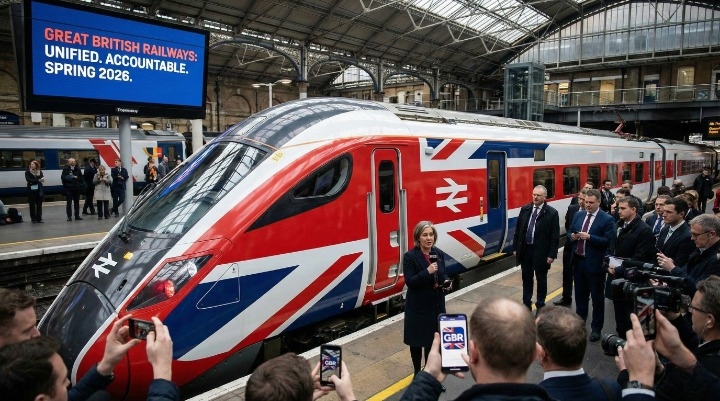
As of this morning, December 9, 2025, the new “Great British Railways” (GBR) livery has officially been unveiled at London Bridge station.1 The stark red, white, and blue design, complete with a modernised version of the iconic “double arrow,” signals the end of the fragmented franchising era that has defined UK travel since the 1990s.2
But for the daily commuter standing on a freezing platform in Birmingham or Manchester, a new paint job means nothing if the trains are still late and the tickets are still overpriced.
With the Railways Bill passing its Second Reading in Parliament today, the legal framework is finally catching up to the rhetoric. This article cuts through the political noise to tell you exactly when your local line nationalises, how the new app aims to kill off booking fees, and whether this “Guiding Mind” can actually fix your morning commute.
What is Great British Railways? (The “One-Stop” Vision)
Great British Railways is the new public body designed to replace the tangled web of 17 different private operators and Network Rail.3 Think of it as the “Guiding Mind”, a single entity responsible for both the track (infrastructure) and the train (operations).4
The End of the Franchise Era
For decades, the UK rail system operated on a fracture line: one company owned the tracks (Network Rail), while others ran the trains (Avanti, GWR, Northern, etc.). This often led to a “blame game” whenever things went wrong. If a signal failed, the train operator blamed the network. If a train broke down, the network blamed the operator.
GBR ends this separation.5 Under the Railways Bill 2025, accountability sits under one roof.6 When a train is delayed, there is only one body to blame—and more importantly, one body responsible for fixing it.
The “Double Arrow” Returns: Decoding the New Branding
The branding revealed today by Transport Secretary Heidi Alexander isn’t a total reinvention; it’s a restoration. The classic double arrow symbol remains, but it is now flanked by sharp, angular lines in the Union Flag colours.7
Why this matters: The goal is visual consistency. By Spring 2026, you will start seeing this single brand replace the confusing mix of logos at stations.8 Whether you are in Leeds or London, the signage, uniforms, and information screens will finally look like they belong to the same network.9
The New GBR App: A “One-Stop-Shop” for Commuters
Perhaps the most tangible benefit for passengers isn’t the train livery, but the software in their pockets. The new GBR app is rolling out in beta to coincide with today’s announcement.
Fee-Free Ticketing & The End of “Split-Save” Confusion
If you currently use third-party apps like Trainline, you are likely paying a booking fee on every transaction. The GBR app removes this entirely.10
The Experience Shift:
-
The Old Way: You check three different apps. One offers a “split-ticket” saving but charges a booking fee. Another has the standard fare. A third claims to be cheaper but only for specific operators.
-
The GBR Way: The app is mandated to offer the “Best Fare Guarantee.”11 It automatically calculates the cheapest route—including split ticketing options, without charging a booking fee.12 This is a direct aggressive move to reclaim the 10-15% commission revenue that currently flows to third-party aggregators.
Passenger Assist 2.0
For disabled passengers, the fragmentation of the railways has been a nightmare. Booking assistance to get on a train in Newcastle (LNER) and get off in Birmingham (CrossCountry) often required two separate phone calls or forms.
The new app integrates Passenger Assist across the entire network.13 A single tap alerts staff at your departure, interchange, and arrival stations, regardless of which legacy operator is running the train. This is a critical requirement of the new legislation, ensuring accessibility is a right, not an administrative hurdle.
Official Timeline: When Will My Train Be Nationalised?
This is the most common misconception: “Nationalisation” isn’t happening overnight. It is a rolling process based on contract expiry dates.
The government is using a mechanism called the Operator of Last Resort (OLR) or simply letting contracts expire to bring lines under GBR control.14 Here is the current status of the major lines as of December 2025.
The “Franchise Death Watch” Table (Updated Dec 9, 2025)
| Operator | Current Status | Transition Date (Confirmed/Expected) |
| South Western Railway | Nationalised | Transferred May 2025 |
| c2c | Nationalised | Transferred July 2025 |
| Greater Anglia | Nationalised | Transferred October 2025 |
| West Midlands Trains | Private (Abellio/JR) | February 2026 (Contract Expiry) |
| Chiltern Railways | Private (Arriva) | March 2026 (Projected) |
| Govia Thameslink (GTR) | Private (Govia) | May 2026 |
| Great Western Railway (GWR) | Private (FirstGroup) | Late 2026 |
| Avanti West Coast | Private (FirstGroup) | 2027 (Long-term contract) |
| CrossCountry | Private (Arriva) | 2027 |
Source: DfT Public Register of Rail Passenger Contracts & Dec 2025 Press Briefing.
The Spring 2026 Rollout
While the management of lines like SWR and c2c has already moved to the public sector, the physical changes will begin in earnest in Spring 2026.15 This is when the new GBR headquarters in Derby will become fully operational, and the first trains repainted in the new livery will enter service on the West Midlands and Thameslink lines.
The “Fine Print”: What Nationalisation Means for Your Wallet
A new logo doesn’t automatically mean a cheaper ticket.16 It is vital to manage expectations regarding costs.
The Truth About the Fare Freeze
The government has announced a fare freeze to accompany the launch of GBR.17 However, you need to check the fine print.
-
Regulated Fares: The freeze applies to season tickets, off-peak returns, and anytime singles. These prices are set by the government.
-
Unregulated Fares: Advance singles and first-class tickets are still subject to “dynamic pricing” (similar to airline tickets). While GBR aims to simplify this, demand-based pricing isn’t disappearing.
Expert Insight: The biggest financial win for commuters won’t be a slash in ticket prices, but the introduction of flexible season tickets that actually work. GBR is prioritising “3-days-a-week” passes that offer genuine savings over buying daily tickets—something the rigid franchise system failed to implement effectively post-pandemic.
Will Trains Actually Be Cheaper?
Short answer: Marginally, due to the removal of booking fees.
Long answer: The primary goal of GBR is efficiency, not subsidy. By merging track and train, the government estimates savings of £1.5 billion a year. In theory, this money will be reinvested to keep fare rises below inflation, but do not expect a 50% price drop overnight.
Frequently Asked Questions
Will my Trainline app still work?
Yes. Third-party retailers can still sell tickets, but they will find it harder to compete now that the official GBR app offers the same “split-save” features with zero booking fees.18
Is Great British Railways the same as British Rail?
Not exactly. British Rail (1948–1997) was a state monopoly that often struggled with funding. GBR is a “Guiding Mind” model.19 It controls the strategy and collects the revenue, but it may still contract private companies to physically run the trains on a fee basis (concessions), similar to how Transport for London runs the Overground.
Who is the current Transport Secretary leading this?
Heidi Alexander is the current Transport Secretary.20 She has been the driving force behind the accelerated timetable for the Railways Bill in late 2025.
What happens if my train is delayed under GBR?
The “Delay Repay” system is being unified. Instead of navigating different rules for different operators (e.g., 15 minutes vs. 30 minutes), GBR introduces a standard “15-minute” compensation trigger across the entire network, processable directly through the GBR app.
Does GBR cover Scotland and Wales?
Rail is a devolved matter.21
-
Scotland: ScotRail is already effectively nationalised (owned by the Scottish Government). GBR will work in partnership with Transport Scotland but won’t directly run it.
-
Wales: Transport for Wales (TfW) is also devolved.22
-
England: GBR is primarily focused on the English network and cross-border services.
Summary
The launch of Great British Railways marks the biggest shift in UK transport policy in 30 years. The fragmented days of blaming “the other guy” for delays are ending.
-
The Brand: A unified red, white, and blue identity arriving Spring 2026.23
-
The App: A single place to book tickets with no fees and better accessibility.24
-
The Reality: Nationalisation is a process, not an event.25 Check the table above to see when your line joins the fold.
My Final Thought: The success of GBR won’t be measured by how good the logo looks on a press release. It will be measured on a Tuesday morning in November, when a signal fails outside Clapham Junction. If the problem is fixed faster and the passengers are compensated instantly via the app, GBR will have succeeded.
Next Step: The beta version of the GBR app is available for download as of today. We recommend installing it alongside your current ticketing app to compare prices on your next journey—you might just save that £1.50 booking fee immediately.
About the Author

Talking about the Railways. I wish they could plan to Expand Holyhead Ferryport Railway Station as it never changes at all. And I wish they could plan a Underwater Tunnel from Great Britain to Ireland as well. Ether to Dublin Connolly or Dun Laoghaire. Thats with a Brand New Train Service from London Euston to Londonderry via Belfast Central and Drogheda.