Nose Piercing UK: The 2026 Essential Guide to Laws, Costs, and Safe Healing
The “curated ear” trend has officially migrated to the face. By early 2026, the demand for high-end, styled nose piercings in the UK surged, with industry reports noting a sharp rise in double-nostril and septum projects. But here is the reality check: a nose piercing is a medical procedure performed in a retail environment. Get it right, and you have a stunning addition to your aesthetic. Get it wrong, and you face the dreaded “piercing bump,” rejection, or worse.
Navigating the UK’s unregulated piercing market can feel like a postcode lottery. Laws change depending on whether you are in London, Cardiff, or Glasgow. Safety standards vary from clinical excellence to back-room hazards.
This guide acts as your definitive roadmap. We will strip away the confusion surrounding nose piercing UK laws, break down the exact costs you should expect to pay in 2026, and detail the medical-grade aftercare required to ensure your new modification heals flawlessly.
What is the Legal Age for a Nose Piercing in the UK? (2026 Update)
One of the most common questions searched online is about age limits. The answer is not as straightforward as a single number because the UK does not have a blanket “national minimum age” for nose piercings in the same way it does for tattoos (which is strictly 18+).
England, Wales, and Northern Ireland: The “Local Authority” Rule
In England, Wales, and Northern Ireland, no statutory law explicitly bans a minor from getting a cosmetic body piercing. Instead, the power lies with Local Authorities.
Under the Local Government (Miscellaneous Provisions) Act 1982 (and similar acts in London), councils set their own bylaws.
- The Standard: Most reputable studios will not pierce anyone under 16 without parental consent.
- The Reality: If you are under 16, a parent or legal guardian must usually accompany you to the appointment and sign a consent form.
- Verification: You and your parent will need valid photo ID (Passport or Driving Licence). A student card rarely suffices.
[GOV.UK – Local council byelaws for skin piercing]
Scotland’s Stricter Stance: The Civic Government Act
If you are north of the border, the rules are tighter. The Civic Government (Scotland) Act 1982 (Licensing of Skin Piercing and Tattooing) Order 2006 sets clearer boundaries.
- Under 16: You strictly require parental consent. The parent must be present in the room during the procedure.
- 16+: You can legally consent to a nose piercing without parental permission.
Studio vs. Law: Why many UK shops say “No” to under-14s
You might find a studio that technically can pierce a 13-year-old legally, but refuses to do so. This is a sign of a good studio.
Pro-Tip: Insurance policies for professional piercers in the UK often set a minimum age of 14 or even 16 for facial piercings. A piercer risking their insurance to make a quick £30 on a minor is a red flag. If they cut corners on insurance, they likely cut corners on sterilization too.
How Much Does a Nose Piercing Cost in the UK?
In 2026, the phrase “you get what you pay for” has never been truer. Cheap piercings often lead to expensive problems. The cost of a nose piercing in the UK is split into two parts: the service fee (the piercer’s time and sterile setup) and the jewellery cost.
Breakdown of Studio Fees vs. Jewellery Quality
Below is the average pricing landscape for reputable UK studios in 2026.
| Service Type | Service Fee (Avg) | Basic Titanium Jewellery | Total Typical Cost |
| Standard Nostril | £25 – £35 | £15 – £25 | £40 – £60 |
| Septum | £30 – £45 | £20 – £30 | £50 – £75 |
| High Nostril | £35 – £50 | £15 – £25 | £50 – £75 |
| Gold Upgrade | (Fee same as above) | £60 – £200+ | £85 – £250+ |
Note: If you see a shop offering a “Nose Piercing for £15 including jewellery,” walk away. High-quality single-use needles and autoclave sterilization cost money. A £15 piercing is mathematically impossible to perform safely without cutting corners.
The Hidden Cost: Why “Implant Grade” Matters
Your initial jewellery must be Implant-Grade Titanium (ASTM F-136).
This material is bio-compatible and complies with the EU/UK Nickel Directive, meaning it will not react with your bodily fluids.
- Avoid: “Surgical Steel” (often contains nickel).
- Avoid: Sterling Silver (oxidizes and stains the skin black).
- Avoid: 9ct Gold (too soft and contains reactive alloys).
If you want the gold look, opt for anodized titanium (safe and cheap) or 14k/18k solid gold (safe but pricey).
Nostril vs. Septum Piercing: Which is Right for You?
Choosing between a nostril placement and a septum depends on your anatomy and lifestyle.
Anatomy and “The Sweet Spot”
- The Nostril: Placed on the crease of the nose wing. A skilled piercer will check your “flare” (how your nostrils move when you breathe) to ensure the stud sits flat.
- The Septum: This is not pierced through the hard cartilage. A professional finds the “sweet spot” (the columella)—a thin strip of soft skin near the tip of the nose, sitting just below the hard cartilage.
My Professional Take: If a piercer clamps your septum and you feel crunching cartilage, they missed the spot. A correctly performed septum piercing is surprisingly low on the pain scale because it goes through a mucous membrane, not hard tissue.
Pain Levels: What to Really Expect
Pain is subjective, but based on industry polls and client feedback:
- Nostril: 4/10. It feels like a sharp pinch or plucking a thick nose hair. Your eyes will water involuntarily—this is a reflex, not crying.
- Septum: 2/10 to 3/10 (if done correctly). It is often described as a sudden pressure or the urge to sneeze.
NHS-Approved Aftercare: The Golden Rules for Healing
Forget the old advice about twisting the stud or using harsh chemicals. Modern aftercare is about doing as little as possible. The NHS and the Association of Professional Piercers (UKAPP) agree on the “Less is More” approach.
The 0.9% Saline Solution: Why Savlon is Out
Do not use Savlon, TCP, tea tree oil, or alcohol. These products are too harsh for a puncture wound; they kill healthy cells and delay healing.
The Routine:
- Wash your hands thoroughly.
- Spray sterile saline solution (0.9% sodium chloride) directly onto the piercing front and back.
- Gently dry the area with non-woven gauze or a hairdryer on the cool setting.
- Leave it alone.
[NHS.uk – Body Piercing Safety and Aftercare]
The 4-Week “Downsize”: The Step Most UK Piercers Forget to Mention
This is the biggest secret to a smooth healing process. When you are first pierced, the bar is extra long to accommodate swelling.
Once the swelling subsides (usually after 4–6 weeks), that extra length becomes a liability. It snags on clothes and moves back and forth, dragging bacteria into the fistula (piercing channel).
You must return to your piercer for a “downsize.” They will swap the long bar for a shorter, flush-fitting post. This simple step prevents 90% of irritation bumps.
Identifying and Fixing “The Piercing Bump” (Granulomas)
You wake up, look in the mirror, and see a red, angry bump next to your stud. Panic sets in. Is it a keloid? Is it infected?
Most of the time, it is a granuloma (irritation bump), not an infection or a keloid.
Is it an infection or just irritation?
- Irritation Bump: Red, shiny, painless or slightly tender. usually caused by snagging the jewellery, sleeping on it, or failing to downsize.
-
Fix: Switch to titanium, downsize the post, and stop touching it.
-
- Infection: The area is hot to the touch, extremely painful, throbbing, and leaking dark yellow or green pus that smells bad. You may feel feverish.
When to call NHS 111
If you suspect an infection:
- Do NOT remove the jewellery. Taking it out can cause the hole to close, trapping the infection inside (an abscess).
-
Contact your GP or call NHS 111 immediately. They may prescribe antibiotics.
How to Choose a Licensed UK Piercing Studio
Don’t trust a shop just because it has a flashy Instagram page. Use this checklist to verify their safety standards.
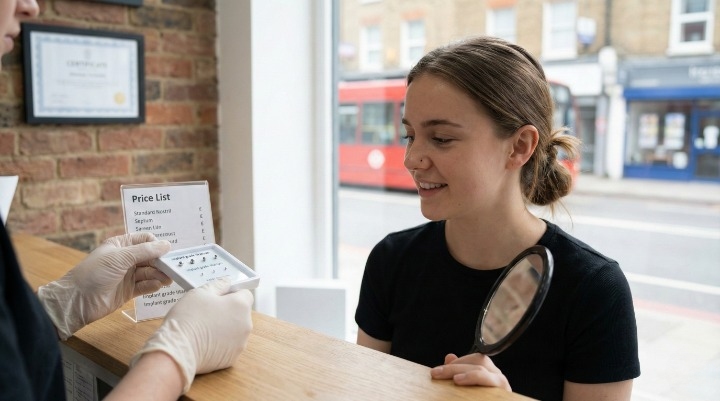
- Licence Display: Under UK law, the studio and the individual piercer must be registered with the local council. Look for the certificate on the wall.
- The Autoclave: Ask to see their sterilization room. They should have a working vacuum autoclave (Class B is standard).
- Needles vs. Guns: A professional never uses a gun for a nose piercing. Guns force a blunt stud through the tissue, causing trauma and shattering cartilage. Needles are hollow, sharp, and laser-cut for precision.
- Jewellery Mill Certificates: A high-end studio can show you certificates verifying their titanium comes from reputable US or UK manufacturers (like Anatometal or Industrial Strength).
Conclusion
Getting a nose piercing in the UK is a rite of passage for many, but it requires respect. It is not just a hole in your face; it is a commitment to weeks of care and months of healing. By adhering to 2026 safety standards—choosing implant-grade titanium, following the NHS saline protocol, and strictly avoiding piercing guns—you ensure your modification remains a permanent, pain-free part of your style.
Remember, the cheapest price often carries the highest risk. Invest in a professional who values your safety as much as your aesthetic.
Ready to book? Don’t guess. Download our free “Safe Studio Checklist” or search the UKAPP member directory to find a verified professional near you.
About the Author