Wuthering Heights Movie 2026: Everything You Need to Know About Emerald Fennell’s Gothic Reboot
Sales of Emily Brontë’s 1847 classic have surged by 469% this week at Waterstones. Why? Because Emerald Fennell has finally dragged the Brontës into the “Brat” era.
Released in UK cinemas on 13 February 2026, the new Wuthering Heights movie has done exactly what a good Gothic romance should do: it has seduced half the country and absolutely enraged the other half. With a 71% score on Rotten Tomatoes and a soundtrack that thumps harder than a night at Fabric, this isn’t the polite, bonnet-wearing drama your English teacher showed you on a rainy Tuesday.
Fennell’s adaptation, produced by LuckyChap Entertainment, swaps traditional lace for what she calls “elegant and brutal” aesthetics. But is it a masterpiece of modern cinema, or just Saltburn in a corset?
This guide breaks down the 2026 cast, the authentic Yorkshire Dales locations, and why this specific version of Wuthering Heights has become the most divisive film of the decade.
The 2026 Cast: Robbie, Elordi, and the “Whitewashing” Debate
Casting is always a bloodsport in the UK, especially when you touch a national treasure like Brontë. The 2026 ensemble is star-studded, undeniably gorgeous, and deeply controversial.
Margot Robbie as Catherine Earnshaw
Margot Robbie steps into the muddy boots of Catherine Earnshaw, delivering a performance that The Guardian (2026) describes as “feral, unhinged, and utterly captivating.” Unlike previous iterations that played Catherine as a victim of circumstance, Robbie leans into the character’s selfishness.
She captures the toxicity of the relationship perfectly. There is a specific scene, roughly 40 minutes in, where Robbie’s Catherine isn’t just pining; she is actively destroying the emotional stability of everyone at Thrushcross Grange. It is a brave choice. She drops the Hollywood sheen to scream until her voice cracks, embodying the “unquiet sleeper” Brontë wrote about.
Jacob Elordi’s Heathcliff: A Byronic Hero or Casting Misfit?
Here lies the heart of the firestorm. Jacob Elordi plays Heathcliff, the brooding anti-hero found on the streets of Liverpool.
Critic’s Notebook:
“Watching Elordi tower over the rest of the cast, he is 6’5”, adds a menacing physicality to the role that we haven’t seen since maybe Timothy Dalton. He doesn’t just walk into a room; he looms. However, the visual chemistry often feels more like a Vogue editorial than 19th-century starvation.”
The casting sparked immediate backlash from literary scholars. In the novel, Heathcliff is explicitly described as “dark-skinned” or “lascar” (a sailor from India or Southeast Asia). Andrea Arnold’s 2011 adaptation honoured this by casting James Howson.
By casting Elordi, a white Australian actor, critics argue the film erases a crucial layer of Heathcliff’s ostracisation. He isn’t just hated because he is poor; he is hated because of his race. In the 2026 Wuthering Heights movie, that racial tension is replaced with class warfare, which, while potent, feels like a simplified reading of the text.
Supporting Stars: Martin Clunes and Hong Chau
The supporting cast provides the gravitas needed to ground the film. Hong Chau shines as Nelly Dean, the narrator and housekeeper. She plays Nelly not as a passive observer, but as a conspirator, someone who knows where the bodies are buried because she helped dig the holes.
Then there is Martin Clunes as Mr. Earnshaw. Known to millions as Doc Martin, Clunes sheds all warmth here. His portrayal is grizzled and weary, a man beaten down by the wind and his own children. It is a small role, but he makes every minute count.
Behind the Music: The Charli XCX “Wuthering Heights” Album
If you expected sweeping violins, you are at the wrong screening. The soundtrack is a collision of Anthony Willis’s orchestral score and the industrial pop of Charli XCX.
“Elegant and Brutal”: Analyzing the Soundtrack
Fennell stated in her Empire Magazine interview that she wanted the film to sound “like a panic attack.” She succeeded.
The soundscape is jarring by design. During the famous “Let me in!” window scene, the audio cuts out completely, leaving only the sound of wind and breaking glass, before smashing into a distorted synth track.
| Scene | Traditional Score (Willis) | Modern Track (Charli XCX) | Effect |
| The Moors Intro | Low cello drones | None | Creates isolation/dread. |
| The Ball | None | “Club Classics” (Remix) | Anachronistic shock; highlights Catherine’s mania. |
| Heathcliff’s Return | Swelling brass | Industrial bass thrum | Signals danger rather than romance. |
The John Cale Collaboration: “House” and Gothic Noir
The standout track is a collaboration between Charli XCX and velvet underground legend John Cale. Titled House, it plays over the closing credits. It is a haunting mix of spoken word and electronic beats that feels spiritually closer to the novel’s darkness than any period-accurate lute music could achieve.
Filming Locations: A UK Guide to the “New” Moors
You cannot film Wuthering Heights in a studio. You need the mud. You need the grey sky. You need the Yorkshire Dales.
Swaledale and Arkengarthdale: The Real Wuthering Heights?
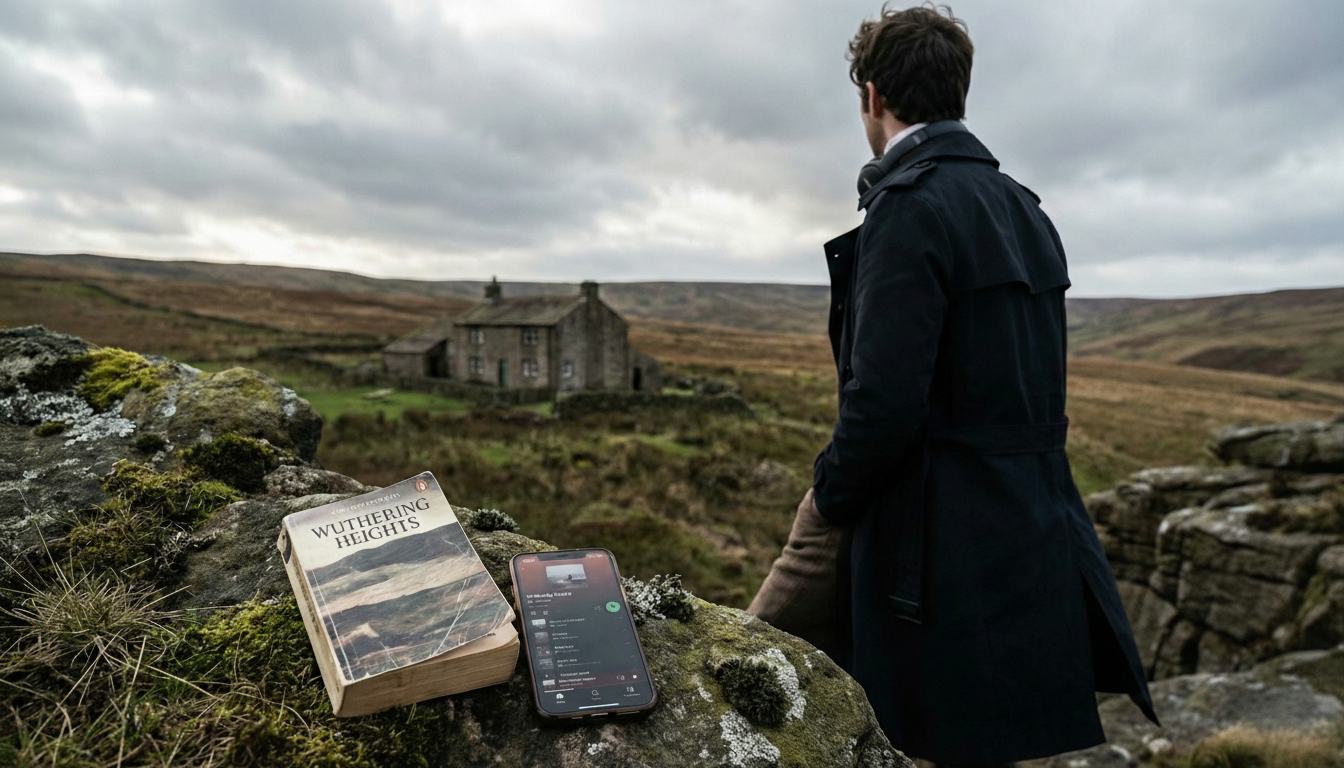
According to Ordnance Survey (2026), the production team avoided the tourist-heavy Haworth (where the Brontës actually lived) and moved north to the wilder, bleaker valleys of Swaledale and Arkengarthdale.
The farmhouse used as Wuthering Heights was built from scratch near the Old Gang Smelt Mill. This is a lead mining ruin that looks like a skeleton on the hillside. The production design team used local stone to ensure the house looked like it grew out of the rock.
Local’s Pro-Tip:
If you are planning a “set-jetting” trip to Arkengarthdale, do not rely on Google Maps. The signal dies the moment you leave Reeth.
- Gear: Wear proper hiking boots. The “moors” are essentially giant sponges.
- Visit: The Tan Hill Inn (Britain’s highest pub) is nearby. The cast was reportedly regulars there during the six-week shoot.
- Warning: The weather turns in minutes. As the locals say, “If you don’t like the weather, wait five minutes and it’ll hail.”
Bridestones Moor and the 200-Person Crew
For the exterior shots of the moors, the crew set up camp on Bridestones Moor. Managing a 200-person crew in a protected National Park required military precision. Natural England monitored the shoot to ensure the fragile peat bog wasn’t damaged by heavy camera dollies.
The result is cinematographically stunning. Shot on 35mm film by Linus Sandgren, the graininess gives the heather a bruised, purple texture that digital cameras often miss.
Why Literary Purists Are Fuming: Adaption vs. Reinvention
It wouldn’t be a Wuthering Heights movie without an argument about the book.
The “Half-Novel” Trap: What Was Left Out?
Like the 1939 Laurence Olivier version, Fennell’s 2026 film commits the cardinal sin for purists: it stops halfway.
The novel is a multi-generational saga. It tells the story of Heathcliff and Catherine, but then continues to tell the story of their children (Cathy and Linton). This film ends [External Link: spoiler-free discussion on BFI] shortly after Catherine’s death.
By cutting the second generation, the film loses the story’s redemption arc. We are left only with the tragedy and the revenge. It makes for a tighter, punchier 136-minute film, but it misses Brontë’s wider point about how trauma echoes through generations.
Anachronisms and “Saltburn-Core” Visuals
Critics at The Independent noted that the dialogue often drifts into modern territory. At one point, Isabella Linton uses phrasing that sounds more like a 2026 TikTok trend than 1840s English.
Fennell is known for her stylized, saturated visuals (dubbed “Saltburn-Core” by Gen Z). While this worked for a satire of the aristocracy, seeing Heathcliff lit in neon blue moonlight feels jarring to those who want grit and grease. It is beautiful, yes, but is it Wuthering Heights?
UK Age Rating & Content Warnings (15 Certificate)
Parents hoping to take their children to see a “classic literature” film should pause. The British Board of Film Classification (BBFC) has granted the film a 15 certificate.
Why the 2026 Film is Rated 15
The BBFC citation is clear. The rating is due to:
- Strong Sex: The intimacy scenes are prolonged and focused on the destructive, consuming nature of the characters’ lust.
- Coercive Control: The film does not shy away from the abusive dynamics of Heathcliff’s marriage to Isabella.
- Disturbing Imagery: There are scenes involving animal cruelty (faithful to the book) that are difficult to watch.
This is not a cozy Sunday night drama. It is a psychological horror wrapped in a romance.
Cinematic History: How 2026 Compares to Olivier (1939) and Hardy (2009)
To understand where this film sits, we must look at the timeline.
| Year | Director | Heathcliff | Key Difference |
| 1939 | William Wyler | Laurence Olivier | The “Hollywood” version. Romantic, polished, and removed all the dirt. |
| 1992 | Peter Kosminsky | Ralph Fiennes | The “Gothic” version. focused heavily on the ghostly elements. |
| 2011 | Andrea Arnold | James Howson | The “Realist” version. No music, hand-held cameras, and racially accurate casting. |
| 2026 | Emerald Fennell | Jacob Elordi | The “Pop-Art” version. Highly stylized, modern soundtrack, and provocative. |
The 2026 Wuthering Heights movie will likely age as a time capsule of our current obsession with “vibes” over strict narrative accuracy.
Summary
Emerald Fennell has taken a sledgehammer to the period drama genre. Her vision of Wuthering Heights is loud, messy, and visually intoxicating.
Whether you love the “horny” Gothic energy or hate the anachronistic soundtrack, Fennell’s version is an undeniable cultural reset for Brontë fans. It refuses to be boring. It refuses to be safe. True to the novel’s spirit, this film is as destructive and “brutal” as the moors themselves.
If you can look past the casting controversies and the modern flourishes, you will find a film that understands the core truth of Emily Brontë’s work: love isn’t always nice. Sometimes, it’s a haunting.
Have you seen it yet? Share your verdict on our UK film forum or check out our [Guide to the Best Yorkshire Dales Walks] to find the real locations.
FAQs
Is the new Wuthering Heights movie on Netflix?
No, not currently. The 2026 adaptation is a theatrical exclusive released by Warner Bros. It premiered in UK cinemas on 13 February 2026. Following the standard theatrical window, it is expected to stream on Sky Cinema and NOW in the UK later this year, rather than Netflix.
Why is Jacob Elordi controversial as Heathcliff?
The controversy stems from the casting of a white actor (Elordi) as Heathcliff. In Emily Brontë’s 1847 novel, Heathcliff is explicitly described as “dark-skinned” or “lascar” (a 19th-century term for a sailor from South Asia). Critics argue that casting a white actor erases the racial prejudice that is central to Heathcliff’s ostracisation in the original text.
What is the age rating for Wuthering Heights (2026) in the UK?
The film is rated 15 by the British Board of Film Classification (BBFC). This is due to strong sex, scenes of coercive control, domestic abuse, and some disturbing imagery involving animals. It is not suitable for younger children.
Where was Wuthering Heights (2026) filmed?
Filming took place entirely in the UK, primarily in the Yorkshire Dales. Specific locations include Swaledale and Arkengarthdale. The production built the Wuthering Heights farmhouse set near the historic Old Gang Smelt Mill ruins to capture the bleak, authentic atmosphere of the moors.
Did Charli XCX do the whole soundtrack for Wuthering Heights?
No. The film features an original orchestral score by composer Anthony Willis (known for Promising Young Woman). Charli XCX curated and contributed original songs for key moments, including the end-credits track “House” (featuring John Cale), providing the film’s modern, industrial edge.
Is Margot Robbie playing Catherine?
Yes, Margot Robbie plays the lead role of Catherine Earnshaw. Her performance has been noted for its intensity and for highlighting the character’s more “unhinged” and selfish traits, rather than playing her purely as a tragic victim.
Who plays Edgar Linton in the 2026 version?
Edgar Linton is played by Shazad Latif (Star Trek: Discovery, What’s Love Got to Do with It?). His portrayal offers a softer, more sympathetic counterpoint to Elordi’s aggressive Heathcliff.
Is the 2026 movie faithful to the original book?
It is faithful to the spirit but not the letter of the book. Director Emerald Fennell has described it as a “Gothic reinvention.” Major changes include modernised dialogue, anachronistic music, and—like many adaptations—cutting the second half of the novel (the story of Cathy and Linton) to focus entirely on Heathcliff and Catherine.
About the Author