NHS Pay Rise 2026: Confirmed 3.3% Award, April Pay Scales, and Band 5 Review
Quick Summary:
- Confirmed Award: 3.3% consolidated uplift for England & Wales.
- Payment Date: April 2026 (first on-time payment in six years).
- Key Change: Major review of Band 5 nursing profiles announced.
- Scotland: Separate deal confirmed at 3.75%.
On 12 February 2026, the UK government officially confirmed a 3.3% consolidated pay award for more than 1.4 million NHS staff. This announcement marks a significant operational shift: for the first time in six years, the NHS pay rise 2026 will be processed and paid on time in April, avoiding the frustration of months-long delays and complex back-pay calculations.
While Health Secretary Wes Streeting hailed the “timely” nature of the deal as a morale booster, health unions have responded with caution. With RPI inflation currently hovering around 4.2%, many staff members are asking if this 3.3% offer represents a genuine increase or another year of pay erosion.
This guide breaks down the confirmed 2026/27 Agenda for Change (AfC) pay scales, examines the regional differences between Scotland and England, and explains the landmark review of Band 5 nursing roles that could be worth thousands more than the headline percentage.
Confirmed NHS Pay Award 2026/27: At a Glance
The headline figure is 3.3%, but the reality varies depending on where you work and which pay band you sit in. The government has accepted the NHS Pay Review Body (NHSPRB) recommendations in full for England, while devolved nations have taken slightly different approaches to protect their lowest-paid workers.
Here is the snapshot of the confirmed deal:
| Region | Confirmed Award | Effective Date | Key Condition |
| England | 3.3% Consolidated | 1 April 2026 | Includes Band 5 Profile Review |
| Wales | 3.3% (up to 5.9%) | 1 April 2026 | Lowest bands boosted to match Real Living Wage |
| Scotland | 3.75% | 1 April 2026 | Includes “Inflation Guarantee” (CPI + 1%) |
| N. Ireland | 3.3% (Parity) | 1 April 2026 | Subject to Executive budget approval |
SME Insight: The term “Consolidated” is crucial here. Unlike the “one-off” lump sums we saw in 2023/24, a consolidated rise is permanently added to your base salary. This means it boosts your hourly overtime rate, unsocial hours payments, and crucially, your NHS pension contributions immediately.
[Official Written Ministerial Statement HCWS1340 – GOV.UK]
New Agenda for Change (AfC) Pay Scales: April 2026
The following tables show the estimated gross annual salaries for the 2026/27 financial year, based on the confirmed 3.3% uplift applied to the 2025/26 scales.
Note: These figures represent basic pay and do not include High Cost Area Supplements (HCAS) or overtime.
Table 1: Bands 2–4 (Support & Administrative Staff)
The government has applied a “bottom-weighting” approach in Wales and parts of England to ensure no NHS salary falls below the new Real Living Wage of £12.71/hour.
| Band | Experience Level | 2025/26 Pay (£) | New 2026/27 Pay (£) | Monthly Increase (Pre-Tax) |
| Band 2 | Entry Step point | £23,615 | £24,394 | +£65 |
| Band 3 | Entry Step point | £24,071 | £24,865 | +£66 |
| Intermediate | £25,674 | £26,521 | +£70 | |
| Band 4 | Entry Step point | £26,530 | £27,405 | +£73 |
| Intermediate | £29,114 | £30,075 | +£80 |
Table 2: Bands 5–7 (Clinical & Registered Professionals)
Band 5 sees the most significant structural discussion this year (see the Band 5 Review section below), but the baseline 3.3% applies immediately.
| Band | Experience Level | 2025/26 Pay (£) | New 2026/27 Pay (£) | Monthly Increase (Pre-Tax) |
| Band 5 | Entry Step point | £29,970 | £30,959 | +£82 |
| Intermediate (2+ yrs) | £32,324 | £33,390 | +£89 | |
| Top Step (4+ yrs) | £36,483 | £37,687 | +£100 | |
| Band 6 | Entry Step point | £36,483 | £37,687 | +£100 |
| Intermediate (2+ yrs) | £38,443 | £39,711 | +£105 | |
| Top Step (5+ yrs) | £44,057 | £45,510 | +£121 | |
| Band 7 | Entry Step point | £45,035 | £46,521 | +£123 |
| Intermediate (2+ yrs) | £47,647 | £49,219 | +£131 | |
| Top Step (5+ yrs) | £51,488 | £53,187 | +£141 |
Table 3: Bands 8–9 (Senior Management & Leadership)
Senior staff often face the “pension tax trap” when pay rises. However, the abolition of the Lifetime Allowance has mitigated this for many Band 8c and above staff.
| Band | Experience Level | 2025/26 Pay (£) | New 2026/27 Pay (£) | Monthly Increase (Pre-Tax) |
| Band 8a | Entry Step point | £52,399 | £54,128 | +£144 |
| Top Step (5+ yrs) | £58,556 | £60,488 | +£161 | |
| Band 8b | Entry Step point | £60,317 | £62,307 | +£165 |
| Top Step (5+ yrs) | £69,223 | £71,507 | +£190 | |
| Band 8c | Entry Step point | £71,684 | £74,049 | +£197 |
| Top Step (5+ yrs) | £82,887 | £85,622 | +£227 |
The Band 5 Nursing Review: A “Hidden” Pay Boost?
While the 3.3% figure dominates the headlines, the most valuable part of the 2026 deal for nurses sits in the fine print.
The Royal College of Nursing (RCN) has successfully negotiated a comprehensive Job Profile Review for Band 5 roles. This addresses a long-standing grievance: newly qualified nurses today perform complex clinical tasks (IV administration, blood transfusions, complex wound care) that were historically Band 6 responsibilities.
What This Means for You
The review will assess whether thousands of current Band 5 roles should be automatically upgraded to Band 6. If your role is re-banded:
- You move from the top of Band 5 (£37,687) to the bottom of Band 6 (£37,687).
- Crucially, you unlock the Band 6 progression capability, capping out at £45,510 rather than being stuck at the Band 5 ceiling.
Experience Note: How to Prepare
Don’t wait for the review to finish. Start documenting your “expanded skills” now. Keep a log of every shift where you take charge of the ward, administer complex medications, or supervise students. When the review framework launches in late 2026, you will need this evidence to push for your re-banding.
Is the 3.3% Rise a “Real-Terms” Cut or Increase?
This is the source of the current union friction. The government argues the award is “inflation-busting” based on the Office for Budget Responsibility (OBR) forecast. The unions argue it is a cut based on the Retail Price Index (RPI).
Let’s look at the numbers objectively:
- OBR Forecast Inflation (2026/27): 2.2%
- Government Pay Award: 3.3%
- Result (Gov View): A 1.1% real-terms increase.
However, the unions (Unison and GMB) point to the RPI, which currently sits at 4.2%. This index includes housing costs like mortgage interest payments, which have remained high.
- RPI Inflation: 4.2%
- Government Pay Award: 3.3%
- Result (Union View): A 0.9% real-terms cut.
The Productivity Trade-Off
The Treasury has only funded 2% of this rise. The remaining 1.3% must be found through “efficiency savings” by Integrated Care Boards (ICBs). In plain English, this often means:
- freezes on non-clinical vacancies.
- Reduction in agency staff spend.
- Delays in capital projects (building repairs).
[Read the full RCN response to the 2026 pay award]
Regional Breakdown: Why Scotland Gets More
Devolution creates a disparity in NHS pay. If you work near the border, the difference is noticeable.
Scotland: The 3.75% Deal
The Scottish Government has committed to a higher headline rate of 3.75%. This is part of a two-year deal agreed upon in 2025 which included an “Inflation Guarantee.” This clause ensures Scottish NHS pay will always sit at least 1 percentage point above the CPI average.
Wales: Focus on the Lowest Paid
The Welsh Government has mirrored the English 3.3% for most bands but applied a “living wage top-up” for Band 2. This results in an effective increase of 5.9% for the lowest-paid staff (porters, cleaners, healthcare assistants), bringing their entry wage to roughly £12.85/hour.
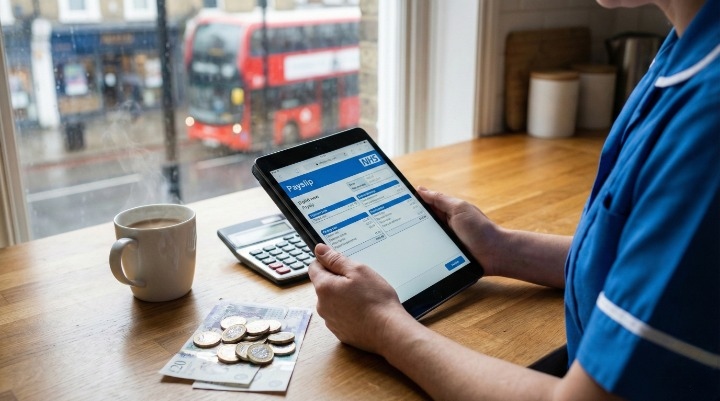
What to Check on Your April 2026 Payslip
Since this pay award is being implemented in April (on time), your payslip will look different than in previous years where you received massive “back-pay” lump sums in September or October.
Here is your checklist for pay day:
- Basic Pay: Ensure your new annual salary matches the New 2026/27 Pay column in the tables above.
- HCAS (London Weighting): The High Cost Area Supplement should also increase by 3.3%. Check that your Inner, Outer, or Fringe allowance has adjusted.
- Pension Tier: A higher salary might tip you into a higher pension contribution tier.
-
-
Example: Moving from £29,114 to £30,075 (Band 4) keeps you in the same 8.3% contribution tier, but moving from Band 7 entry (£46,521) to intermediate (£49,219) pushes you closer to the 12.5% bracket threshold.
-
- No “Arrears”: Because this is being paid in the correct month, you should not see an “Arrears of Pay” line. This is good for tax purposes, as it prevents you from being artificially pushed into a higher tax bracket for a single month.
FAQs
Is the 2026 NHS pay rise backdated?
No, and it doesn’t need to be. For the first time in recent history, the government has announced the NHS pay rise 2026 before the start of the financial year. The new rates apply from 1 April 2026 and will be included in your April pay packet.
Which NHS staff are excluded from the 3.3% rise?
This award applies to all staff on Agenda for Change (AfC) contracts. This includes nurses, midwives, paramedics, allied health professionals, porters, and admin staff. It excludes doctors and dentists, whose pay is decided by a separate review body (DDRB), and senior VSM (Very Senior Manager) executives.
Will there be NHS strikes in 2026 over pay?
It is possible but less likely than in 2023. While the RCN and Unison have expressed disappointment that the rise is below RPI inflation, the commitment to the Band 5 review and the restoration of on-time payments has cooled immediate strike rhetoric. Consultative ballots are expected in May 2026.
What is the new starting salary for a Band 5 nurse in 2026?
The new starting salary for a newly qualified Band 5 nurse in England is £30,959. In Scotland, the equivalent starting salary is approximately £31,800 due to the higher 3.75% award.
Does the pay rise include High Cost Area Supplements (HCAS)?
Yes. The 3.3% uplift applies to both basic pay and the min/max thresholds of the High Cost Area Supplements for staff working in and around London.
How does the 2026 pay award affect my NHS pension?
The rise is pensionable. Your career average earnings (CARE) pot will grow by the new salary amount. However, you must check if the increase pushes your pensionable pay into a higher contribution bracket, which could slightly reduce your immediate take-home pay.
What is the “Living Wage” guarantee for NHS Band 2 staff?
The government has guaranteed that no NHS worker will earn below the Real Living Wage. For 2026, this required boosting the bottom of Band 2 by more than the standard 3.3% in some regions to hit the £12.71+ hourly equivalent.
When will the Band 5 job profile review be completed?
The review is scheduled to conclude in October 2026, with recommendations for implementation in the 2027/28 financial year.
Conclusion: A Step Forward or a Standstill?
The NHS pay rise 2026 offers stability, if not celebration. Returning to an April implementation cycle is a massive administrative win that allows staff to plan their finances without waiting months for back-pay.
However, the 3.3% figure walks a tightrope. For many, it will barely cover the rising cost of housing and utilities. The real opportunity for significant earnings growth this year lies not in the percentage uplift, but in the Band 5 structural review. If you are a nurse or registered professional, your focus for 2026 should be on gathering the evidence needed to prove your role belongs in a higher band entirely.
Next Step: Don’t just look at the gross figure. Use our updated tools to see what lands in your bank account.
Full 2026/27 NHS Pay Scale PDF
About the Author