How Long Does It Take to Fill in a Cavity? The Complete UK Timeline
Dread the dentist? You are not alone. Waiting in the chair can feel terrifying. But modern dentistry is fast. It is much faster than it used to be. “Getting a cavity filled is usually a painless procedure and can actually help to relieve discomfort” (Winchester Road Dental Practice, 2026). Whether you use the NHS or go private, knowing the exact timeline strips away the stress. Let’s break down the clock.
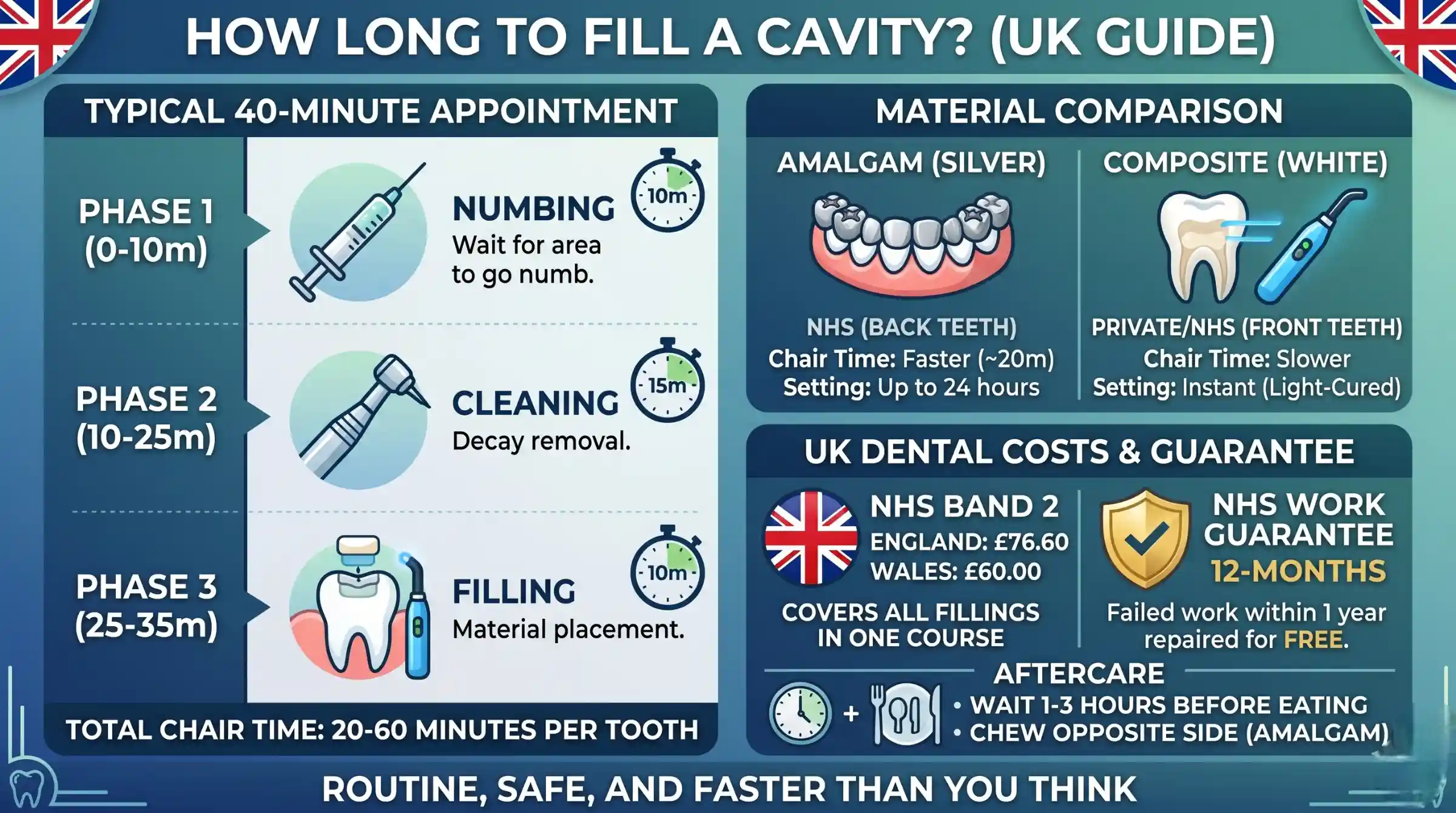
A standard dental cavity filling in the UK typically takes between 20 and 60 minutes per tooth. The exact time depends on the cavity’s size and the material used. The appointment involves 5–10 minutes for anaesthetic, 10–20 minutes to clean the decay, and 10–20 minutes to place the filling.
Key Takeaways
- Standard chair time is 20 to 60 minutes.
- Local anaesthetic takes 5 to 10 minutes to work.
- NHS Band 2 covers all fillings in a single course of treatment.
- Amalgam (silver) sets over 24 hours; Composite (white) cures instantly.
- Wait 1 to 3 hours before eating hot food.
Quick Start: What to Ask Before Your UK Appointment
Before you sit in the chair, get the facts straight. Use this quick checklist.
- Is this treatment provided under NHS Band 2 or privately?
- Are you using amalgam (silver) or composite (white) material?
- If NHS, is it possible to pay a top-up fee for a white filling on a back tooth?
- Will I need to return for a second appointment, or is this a single visit?
The Step-by-Step Filling Timeline (Minute by Minute)
A 45-minute booking does not mean 45 minutes of drilling. That is a common fear.
Common Mistake: Assuming the whole appointment involves active drilling. The actual decay removal only takes 10 to 20 minutes. Much of the remaining time is spent just waiting for the area to go numb.
Here is exactly what happens during a standard 40-minute appointment:
- Minute 0 to 10: Local anaesthetic application. You wait for the numbness to take effect.
- Minute 10 to 25: Decayed tissue removal. The dentist thoroughly cleans the cavity.
- Minute 25 to 35: Application of the filling material. This is layered and light-cured for composite, or packed tightly for amalgam.
- Minute 35 to 40: Bite alignment check. The dentist shapes and polishes the surface.
Pro Tip: If you suffer from dental anxiety, know that composite fillings require precise “dry” conditions. This means the dentist will use suction tools longer to keep the tooth free of saliva. Knowing this timeline in advance helps manage expectations in the chair.
NHS vs Private Fillings: Materials and Curing Times
The material your dentist uses changes your timeline. It also changes what happens after you leave the clinic.
A patient getting a silver amalgam filling spends about 20 minutes in the chair. But they must avoid chewing hard foods on that side for a full 24 hours while the material achieves maximum strength (Harrow Dental Practice, 2023).
Composite is different. A patient receiving a white composite filling has the material applied in thin layers. It is instantly hardened by the dentist using a specialised blue curing light. This lets them eat as soon as the numbness fades (Bupa Dental Care, 2026).
As experts note: “Composite fillings cure instantaneously with a curing light, while materials such as amalgam… require more time to completely set” (Myra Dental, 2026).
| Material | Typical Use | Chair Time Impact | Setting Time | Estimated Lifespan |
| Amalgam (Silver) | NHS (Back teeth) | Quicker to place | Up to 24 hours | Up to 20 years |
| Composite (White) | Private (Or NHS front) | Slower to place | Instant (UV Light) | 12 to 15 years |
You can read more about how materials are selected on the NHS guidance on dental materials page.
Mid-Article Summary
- Amalgam (Silver): Quick to place, requires 24 hours to set fully, and lasts up to 20 years.
- Composite (White): Slower to place, sets instantly via UV light, and lasts 12 to 15 years.
- Actionable Takeaway: Choose your material based on tooth visibility and your budget.
How Much Does a Filling Cost in the UK? (Band 2 Explained)
Dental costs confuse many patients. The NHS simplifies this with banding. In England, standard fillings fall under the NHS Band 2 dental charge. This costs £76.60 for the entire course of treatment.
Pro Tip: Schedule multiple fillings within the same “course of treatment” if your dentist allows it. The NHS Band 2 charge covers all required fillings under a single plan. This saves you money.
For example, a patient requiring three separate cavity fillings in a single visit will only pay the NHS Band 2 fee once, rather than paying per tooth (MoneyHelper, 2026). Residents in Wales pay even less. Their NHS Band 2 dental charge is currently capped at £60.00.
What about white fillings on the NHS? The NHS typically provides silver amalgam for back teeth. Tooth-coloured composite fillings are usually reserved for highly visible front teeth.
Typical Scenario (NHS Front Tooth): A patient chips a highly visible front tooth. Under NHS Band 2 care, the dentist provides a white composite filling at no extra private charge. Clinical aesthetics dictate a white material for front teeth. The procedure takes roughly 40 minutes.
Typical Scenario (Blended Care): A patient attends an NHS check-up and needs a filling on a back molar. Instead of accepting the standard silver amalgam, they opt for a private white filling upgrade. The clinic rolls the cost of the check-up and the private filling together.
You can check exact eligibility rules on the [MoneyHelper NHS dental charges guide] page.
Aftercare: Eating, Drinking, and the 12-Month Guarantee
The drill stops. The chair goes back up. But the treatment is not entirely over. Your mouth will remain numb.
Pro Tip: Do not consume hot beverages or chew food for 1 to 3 hours post-procedure. Wait until the local anaesthetic has completely worn off. This prevents you from severely biting your tongue or cheek.
If you receive an amalgam filling, you must be extra careful. Chew on the opposite side of your mouth for the rest of the day. The material takes up to 24 hours to fully set. To maximise the 12-to-15-year lifespan of a composite resin filling, ensure you floss daily. This stops new decay from forming around the edges of the restoration.
What happens if something breaks? The NHS has rules to protect you. “If something goes wrong with some dental work done by the NHS within 12 months, it should be covered by the NHS guarantee” (MoneyHelper, 2026).
Pro Tip: If your NHS filling cracks, chips, or falls out within a year, contact the exact same dentist immediately. Repairs are generally free under the 12-month NHS dental guarantee. Read more about your protections via Citizens Advice on NHS dental rights.
Summary
Getting a cavity filled is a routine, highly regulated procedure in the UK. It generally takes under an hour. Chair time is fast. The local anaesthetic prevents pain. By understanding NHS banding and material differences, you can sit in the dentist’s chair with confidence.
Next Steps:
- Call your clinic to confirm if your appointment is NHS or private.
- Ask which material will be used for your specific tooth.
- Arrange to eat a soft meal before your appointment, as you will need to wait hours to eat afterward.
FAQs
Does getting a filling hurt?
No. The dentist applies a local anaesthetic before starting. You will feel pressure, but you should not feel sharp pain.
How long does numbness last after a filling?
Numbness from a standard local anaesthetic usually lasts between 1 and 3 hours after the procedure ends.
Can I get a white filling on the NHS?
Yes, but typically only on highly visible front teeth. For back teeth, the NHS standard is silver amalgam, unless you pay privately for a white composite upgrade.
Do I have to pay per tooth on the NHS?
No. If you need multiple fillings done in a single course of treatment, you only pay the Band 2 charge once.
Can I go back to work immediately after a fillin?
Yes. You can return to work right away. Just be careful speaking or drinking while your mouth is still numb.
What happens if my filling falls out within a year?
Under the NHS guarantee, if a filling fails within 12 months, the original dentist should repair or replace it for free.
Are multiple fillings done in one appointment?
Sometimes. A direct filling is usually done in one visit. However, treating multiple cavities may require your dentist to spread the work across multiple appointments to manage chair time and anaesthetic limits.
About the Author