Men’s Snowboard Slopestyle 2026: Su Yiming’s Birthday Gold
On the morning of his 22nd birthday, China’s Su Yiming didn’t just blow out candles; he blew the competition away at the Livigno Snow Park. The Men’s snowboard slopestyle 2026 Winter Olympics final will be remembered not for massive amplitude, but for a razor-thin margin of 0.28 points and a controversial “slow course” that forced athletes to tape their trousers for speed.
While the clear skies over the Italian Alps looked picture-perfect for broadcast, the reality on the snow was a tactical nightmare. The Mottolino course, notorious throughout the practice week for its sluggish mid-section, demanded perfection on the rails. Su Yiming delivered exactly that, securing gold with a score of 82.41, edging out Japan’s Taiga Hasegawa in a final run that silenced the doubters.
Here is the complete debrief of the final, the technical hacks athletes used to survive the course, and what this result means for Team GB.
The Podium: Su Yiming’s 22nd Birthday Masterclass
The tension in Valtellina was palpable. After a qualifying round where favourites fell, the final 12 riders faced a course that punished the slightest speed check.
Gold: Su Yiming (China) – 82.41
Redemption is sweet, but birthday gold is sweeter. After a quiet post-Beijing cycle, Su Yiming returned to the Olympic stage with a run that prioritized flow over raw power.
According to the official Olympics.com scoring breakdown, Su’s winning run was defined by his rail section. He scored a massive 48.55 on the technical features (rails/jibs) compared to 33.86 on the jumps. His ability to lock into a Switch Backside 1260 without scrubbing speed set him up perfectly for the final XL kicker.
The Judge’s Perspective:
“Su didn’t have the biggest air of the day, Taiga did. But Su’s rail work was surgical. He landed high on every transition, carrying energy where others bogged down. That flow is what the judges rewarded.”
Silver: Taiga Hasegawa (Japan) – 82.13
The Japanese sensation came agonizingly close. Hasegawa threw the most technical jump trick of the day—a Cab Triple Cork 1620, but a minor hand drag on the second rail feature cost him valuable execution points. Losing Gold by less than three-tenths of a point highlights just how critical clean landings were on this unforgiving snow.
Bronze: Jake Canter (USA) – 80.05
Sitting in 8th place before his final drop, the American pulled off the comeback of the day. Canter’s run was less technical than the top two but significantly cleaner than the rest of the field. His podium finish ensures the USA remains a dominant force in slopestyle snowboarding.
Final Standings Table
| Rank | Athlete | Nation | Score | Best Trick |
| 1 | Su Yiming | CHN | 82.41 | Switch Backside 1260 |
| 2 | Taiga Hasegawa | JPN | 82.13 | Cab Triple Cork 1620 |
| 3 | Jake Canter | USA | 80.05 | Backside Triple 1440 |
| 4 | Mark McMorris | CAN | 78.50 | Frontside Triple 1440 |
| 5 | Mons Røisland | NOR | 76.25 | Switch Backside 1620 |
[View full official results on FIS-ski.com]
Technical Deep-Dive: The “Aerodynamic Tape” Mystery
If you watched the Men’s snowboard slopestyle 2026 Winter Olympics feed closely, you might have noticed something odd: several riders, including members of the Canadian and Norwegian teams, had duct tape or specialized aerodynamic tape wrapped around their lower trouser legs.
This wasn’t a fashion statement. It was a physics necessity.
The Problem: The “Mottolino Flat”
The Livigno course features a challenging transition between the third rail section and the first jump. Throughout the week, riders complained that the fresh, dry snow at 1,816 metres was creating excessive friction.
The Hack: Reducing Drag
Loose snowboard trousers act like parachutes. In a normal contest, this doesn’t matter. But at Mottolino, speed was the currency.
- The Fix: Riders taped their pant legs tight against their boots to create a streamlined profile.
- The Result: This small adjustment reportedly added 2-3 km/h of speed approaching the first kicker, often the difference between landing a triple cork or crashing onto the knuckle.
This level of improvisation demonstrates the “Experience” factor of veteran teams. While rookies struggled to clear the gap, seasoned squads adapted their gear to the conditions.
Team GB Report: Txema Mazet-Brown’s Olympic Debut
For UK fans, eyes were on 19-year-old Txema Mazet-Brown. While he didn’t make the final 12, finishing in 27th place, his debut offered promising signs for the future of British snowboarding.
Mazet-Brown, who qualified for the Games through gritty performances on the World Cup circuit, struggled with the speed of the course during qualifiers. His first run showed his signature style, a smooth Backside 1080, but he washed out on the landing of the second rail feature.
According to TeamGB.com, the coaching staff viewed these Games as a developmental milestone. Mazet-Brown is one of the few riders in the field with a true “Goofy” stance preference for technical rails, a trait that sets him apart. With the Big Air event still to come, his Olympics are far from over.
Analyst Note:
“Txema has the tricks. What he lacked today was the veteran knowledge of how to manage ‘slow snow.’ That comes with experience. Expect him to bounce back in the Big Air, where speed management is less complex.”
Livigno Snow Park: A Venue of Two Halves
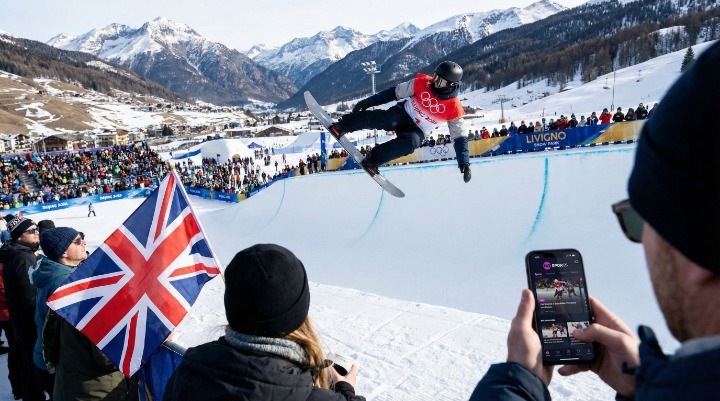
The venue itself played a massive character in today’s drama. The Livigno Snow Park (specifically the Mottolino area) is distinct from previous Olympic courses like Beijing or PyeongChang.
- The XL Jump Line: The final three jumps are massive, with tables exceeding 25 metres. This favours “power” riders like McMorris and Hasegawa.
- The Technical Rail Garden: The top section is tight, technical, and steep. This favours “finesse” riders like Su Yiming.
The layout forced a compromise. You couldn’t just be a jumper; you had to be a rail technician. This balance is why we saw favourites like Red Gerard (USA) fail to qualify, they couldn’t adapt their flow to the aggressive rail transitions.
Venue Specs:
- Elevation: 1,816m – 2,069m
- Vertical Drop: 253m
- Length: 800m
- Features: 3 Jumps, 3 Rail Sections
Where to Watch: UK Broadcast Schedule & Replays
If you missed the live action, the replays are essential viewing, especially to analyze the judging controversy on the silver medal run. Here is how to watch the Men’s snowboard slopestyle 2026 Winter Olympics coverage in the UK.
Primary Broadcasters
- TNT Sports / discovery+: The home of the Olympics in the UK. They hold the rights to every minute of the action.
-
-
Pro Tip: Use the discovery+ app timeline feature to jump straight to Su Yiming’s final run.
-
- BBC One / BBC iPlayer: The BBC provides excellent curated coverage, including highlights and key live moments.
The “No-Commentary” Hack
For the purists who want to hear the sound of edges on ice and the wind on the kickers:
- Open the discovery+ app.
- Navigate to the “Snowboard” category (not the main “Live” feed).
- Select the “World Feed” option.
- This stream has no commentators, just the raw stadium sound. It creates a much more immersive experience, letting you hear the athletes calling their drops.
Summary: A Game of Millimetres
The 2026 Slopestyle final wasn’t the progression-fest some predicted, but it was a masterclass in tactical snowboarding.
- Su Yiming proved that technical rail mastery beats pure jump amplitude.
- The Course dictated the riding, forcing athletes to tape their gear to combat friction.
- Team GB continues to build experience, with young talents like Mazet-Brown gaining vital seat time at the highest level.
As the focus now shifts to the Big Air competition later this week, the question remains: Can anyone stop Su Yiming now that he has his confidence back?
Did the judges get the score right? Was Hasegawa robbed of Gold? Share your thoughts in the comments below.
FAQs
Who won the Men’s Snowboard Slopestyle in 2026?
Su Yiming of China won the Gold medal with a score of 82.41, secured on his final run.
Why were Olympic snowboarders taping their trousers?
Athletes used tape to tighten their trousers around their boots to improve aerodynamics. The snow at Livigno was dry and slow, so reducing drag was essential to clear the large jumps.
How old is Su Yiming?
Su Yiming turned 22 years old on the day of the final, 18 February 2026.
What happened to Mark McMorris in 2026?
The Canadian veteran finished 4th. Despite a clean run, his technical difficulty on the rails was scored lower than the podium finishers.
Where is the Livigno Snow Park located?
The park is located in the Valtellina valley of the Italian Alps. The specific course was on the Mottolino ski area, sitting at an altitude of over 1,800 metres.
Who is Team GB’s top snowboarder in 2026?
Txema Mazet-Brown is the primary British representative in Slopestyle and Big Air. The 19-year-old finished 27th in the Slopestyle qualification.
Is snowboarding slopestyle on the BBC?
Yes, the BBC provides daily highlights and live coverage of select finals on BBC One and BBC iPlayer, though TNT Sports holds the full rights for every run.
About the Author