RAF Jets Scrambled: The Official UK Quick Reaction Alert Protocol
The sudden, rattling crack of a sonic boom is often your only warning. You look up, but the sky is empty. Down below, the UK’s airspace defence network has already sprung into action.
News headlines frequently announce that fighter jets have launched. Yet the actual military protocols stay largely out of public view. What really happens when the alarm sounds?
This guide explains exactly what triggers the Royal Air Force to launch a Quick Reaction Alert (QRA). We detail the command chain, the aircraft involved, and the stark difference between civilian errors and military intercepts.
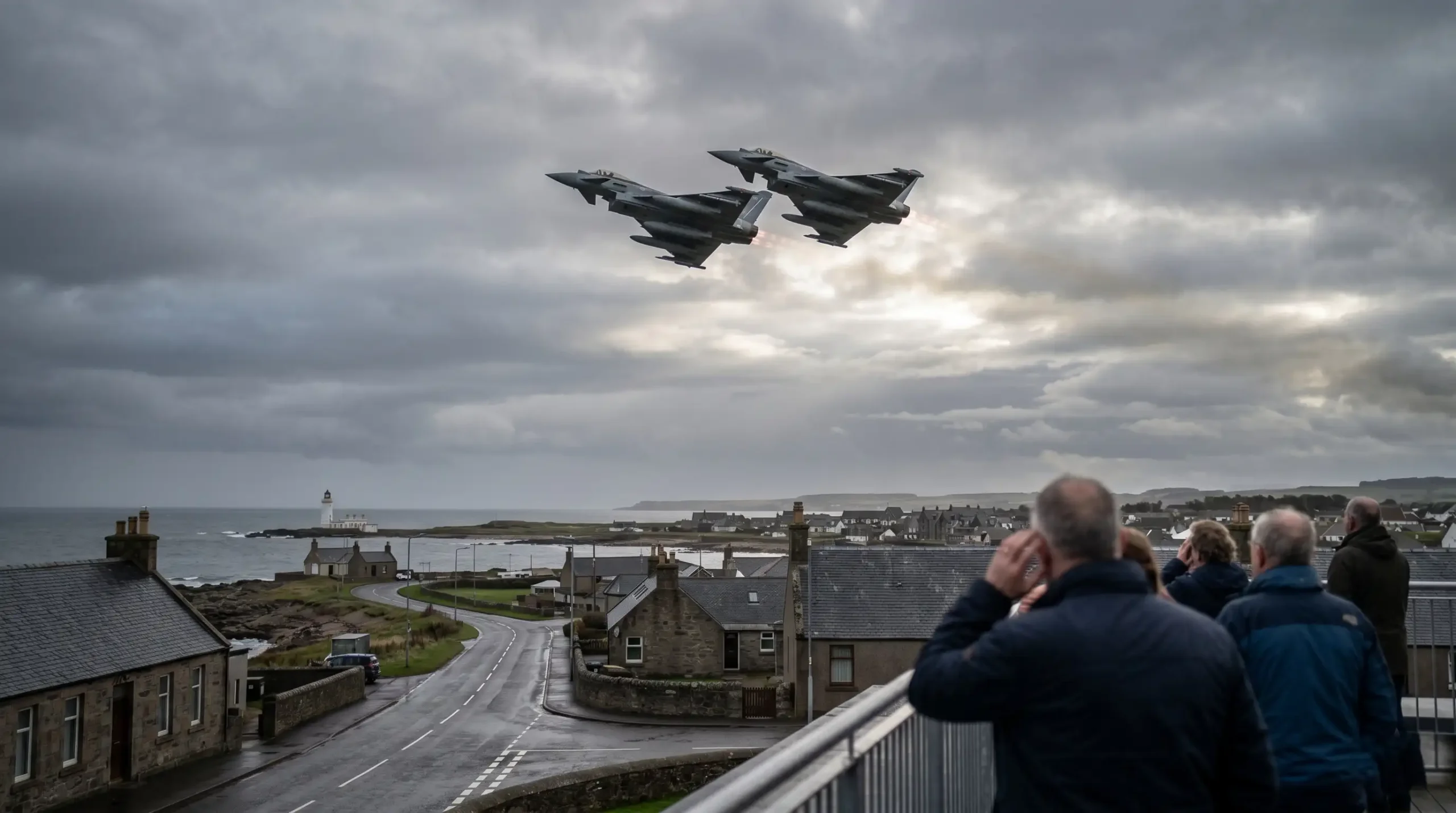
When you hear RAF jets scrambled, it means the Quick Reaction Alert (QRA) force has launched to intercept an unidentified or unresponsive aircraft. Authorised by the National Air and Space Operations Centre, Typhoon fighter jets deploy 24/7 from UK bases to ensure sovereign airspace remains completely secure.
Key Takeaways
- The RAF maintains a continuous 24/7/365 QRA defensive posture.
- Scrambles are predominantly executed by Typhoon FGR4 jets flying out of RAF Lossiemouth or RAF Coningsby.
- A common trigger is a civilian airliner losing radio contact, not just foreign military activity.
- Intercepted Russian military aircraft routinely fly in the UK’s Area of Interest but have not crossed into sovereign UK airspace.
- Loud sonic booms over land usually happen because jets accelerate past the sound barrier to intercept a civilian communication failure.
Sonic Boom vs. Incident Self-Test
Wondering if you just heard a QRA scramble? Ask yourself three questions.
First, did the noise sound like a sudden, explosive double thunderclap rattling your windows? If yes, it is likely a sonic boom from QRA jets accelerating past the sound barrier.
Second, are you located in eastern or southern England, or northern Scotland? These areas sit beneath common flight paths out of RAF bases.
Third, is there a concurrent report of a civilian aircraft squawking code 7600 (meaning a radio failure) on flight tracking radars? If yes, this is a routine scramble trigger.
What Triggers a QRA Scramble in the UK?
Airborne threats fall into two main categories. One is an honest mistake. The other is a deliberate test of border security. Both get the same aggressive initial response.
Civilian Communication Failures (Squawk 7600)
Sometimes, a pilot just loses radio contact. This routine glitch triggers a massive military response.
Imagine a commercial airliner entering UK airspace. Suddenly, the radio fails. Civilian air traffic control cannot raise the pilot and immediately notifies military radar operators. NASOC authorises a scramble.
Typhoons launch and accelerate to supersonic speeds. This often causes a localised sonic boom. The fighter jets intercept the airliner, establish visual contact, and escort it to a designated secure airport like Stansted. They stay right beside the plane until communications are fixed or benign intent is verified.
For example, on August 15, 2025, Typhoons from RAF Coningsby launched to intercept a civilian aircraft from Nice that had lost contact with air traffic control. Authorities safely escorted it to Stansted Airport, causing a loud sonic boom over Essex during the high-speed intercept.
Common mistake: Do not panic if you hear a sudden explosive noise. A sonic boom over land usually indicates QRA jets accelerating to intercept a civilian aircraft experiencing a temporary radio failure, not an attack.
Foreign Military Aircraft in the Area of Interest
The second trigger involves foreign military forces. Ground radars constantly compile a map of the sky. They detect unidentified military aircraft approaching the UK Area of Interest from the north.
Pilots receive a “call to cockpit” to wait on standby. As the foreign aircraft cross a defined threshold without filing flight plans or communicating on standard channels, the order drops. Typhoons intercept, identify the aircraft, and shadow them continuously until they turn away.
On April 14, 2026, Typhoons from RAF Lossiemouth scrambled to intercept a Russian long-range bomber near the Shetland Islands. A Voyager tanker provided mid-air refuelling. The military shadowed the aircraft closely.
“At no point did these aircraft enter UK sovereign airspace. The Russian aircraft were shadowed by our Typhoons,” confirmed an RAF Spokesperson regarding a similar event. The military draws a strict line between the broader Area of Interest and sovereign UK airspace.
The Exact Chain of Command for UK Intercepts
A scramble is not a random decision by a local base commander. It follows a highly structured sequence. A QRA scramble requires intense, real-time coordination between civilian air traffic controllers and military command systems.
Here is exactly how the order flows:
- Detection: Integrated ground radars detect an unidentified airborne threat entering the monitoring zone.
- Analysis: The Control and Reporting Centre (CRC) at RAF Boulmer reviews the data and compiles a live Recognised Air Picture.
- Command: The National Air and Space Operations Centre (NASOC) assesses the threat severity and officially issues the scramble order.
- Launch: Pilots stationed on high alert at RAF Lossiemouth or RAF Coningsby immediately launch their Typhoon FGR4 jets.
- Resolution: The jets intercept, identify, and escort the target aircraft either out of the area or safely down to the ground.
Where Are RAF Scramble Bases Located?
The UK is split in two. Defence-wise, at least. To cover the entire airspace rapidly, the RAF operates QRA forces from two distinct geographical locations. You must remember that QRA jets operate primarily out of these specific bases. If the threat is up north, RAF Lossiemouth handles it. Down south? RAF Coningsby takes over.
| QRA Base | Sector Defended | Primary Aircraft | Support Elements |
| RAF Lossiemouth | Northern UK / Scotland | Typhoon FGR4 | Voyager Tanker (Brize Norton) |
| RAF Coningsby | Southern UK / England | Typhoon FGR4 | Voyager Tanker (Brize Norton) |
Summary: The Core Command Rules
- QRA operations are controlled by NASOC, not individual airbases.
- The UK is divided into Northern (Lossiemouth) and Southern (Coningsby) interception sectors.
- Both civilian and military incidents trigger the exact same initial launch sequence.
The Aircraft: Typhoons and Voyagers
The Typhoon FGR4 is a beast. It is a multi-role combat aircraft designed for speed, agility, and dominance in the air. When the order drops, pilots push these jets to the absolute limit.
But fighter jets burn fuel fast. Very fast. A scramble is rarely just the fighter jets. You will almost always see Voyager tanker aircraft launch concurrently from RAF Brize Norton. These massive planes provide vital mid-air refuelling. This extends the operational endurance of the fighters indefinitely.
Consider a major event in March 2020. Six RAF fighter jets from both Lossiemouth and Coningsby scrambled to intercept Russian Tupolev Tu-95 Bear bombers approaching Scotland. An air-to-air refuelling tanker launched to fully support them during the massive operation. You can learn more about the exact speeds and capabilities via the official RAF Typhoon specifications.
Why You Heard a Sonic Boom (and What to Do)
A sonic boom happens when an aircraft flies faster than the speed of sound. It pushes air waves together until they merge into a massive shockwave. To you on the ground, it sounds like an explosion.
Do not panic. A double thunderclap over land usually means jets are just accelerating to help a civilian airliner with a broken radio. They need to get there fast.
What should you do? Wait a few moments. Then, check official RAF and Ministry of Defence social media channels. They frequently update the public on QRA launches once the primary phase is complete. Also, do not bother looking at standard civilian flight apps. Military planes often do not transmit standard civilian ADS-B signals during live operational intercepts. They vanish from public tracking.
Common Misconceptions About UK Airspace Intercepts
People assume the worst. A scramble does not mean World War III has started. Most intercepts are purely precautionary.
“Our Quick Reaction Alert force is maintained 24/7 to defend the UK. The RAF remains ready to respond… at a moment’s notice,” a Ministry of Defence spokesperson stated.
Many think Russian jets routinely invade our skies. They do not. You must understand the difference between the UK’s “Area of Interest” and “Sovereign Airspace”. Intercepts happen almost exclusively in the broader Area of Interest. This strictly prevents entry into sovereign territory. The UK maintains a massive buffer zone.
Finally, do not expect precise historical operational numbers regarding these scrambles. You will not find them. The Ministry of Defence purposely restricts aggregate data under the Freedom of Information Act. This policy protects national security and preserves the deterrent capability of the force.
Summary & Next Steps
When RAF jets launch suddenly, it is not a random panic. It is a highly choreographed, 24/7 military protocol. The system works exactly as designed to protect the UK from both civilian aviation mishaps and foreign military probing.
Next Steps:
- Monitor official MoD or RAF social media feeds for post-incident confirmations.
- Review the differences between civilian tracking apps and military radar capabilities.
- Familiarise yourself with the standard flight paths out of RAF Coningsby and RAF Lossiemouth to know if you live in a sonic boom zone.
FAQs
What does it mean when RAF jets are scrambled?
It means the military has launched armed fighter jets on short notice to intercept an unresponsive civilian plane or an unidentified foreign military aircraft near UK airspace.
Why do RAF jets cause sonic booms?
To reach an unresponsive aircraft quickly, Typhoon pilots must fly faster than the speed of sound (Mach 1). Breaking this sound barrier creates a massive pressure wave that sounds like a double explosion on the ground.
Where do RAF quick reaction alert jets fly from?
They operate primarily from two bases: RAF Lossiemouth in Scotland covers the north, and RAF Coningsby in Lincolnshire covers the south.
How fast can a Typhoon jet scramble?
While the exact minute count is classified, pilots are kept on high alert. If they receive a “call to cockpit” prior to the official launch order, they can be airborne in a matter of minutes.
Has a Russian plane ever entered UK airspace?
Despite frequent intercepts, official UK government records state that intercepted Russian military aircraft have not crossed unauthorised into sovereign UK airspace; they are intercepted in the broader UK “Area of Interest.”
How do civilian planes lose communication with air traffic control?
Radio equipment failure, incorrect frequency selection by the pilot, or temporary electrical faults can cause an airliner to “go dark,” triggering a scramble.
Can I track a scrambled RAF jet on a flight tracker app?
Rarely. Military aircraft generally turn off their standard civilian ADS-B transponders during tactical intercepts to maintain operational security.
About the Author