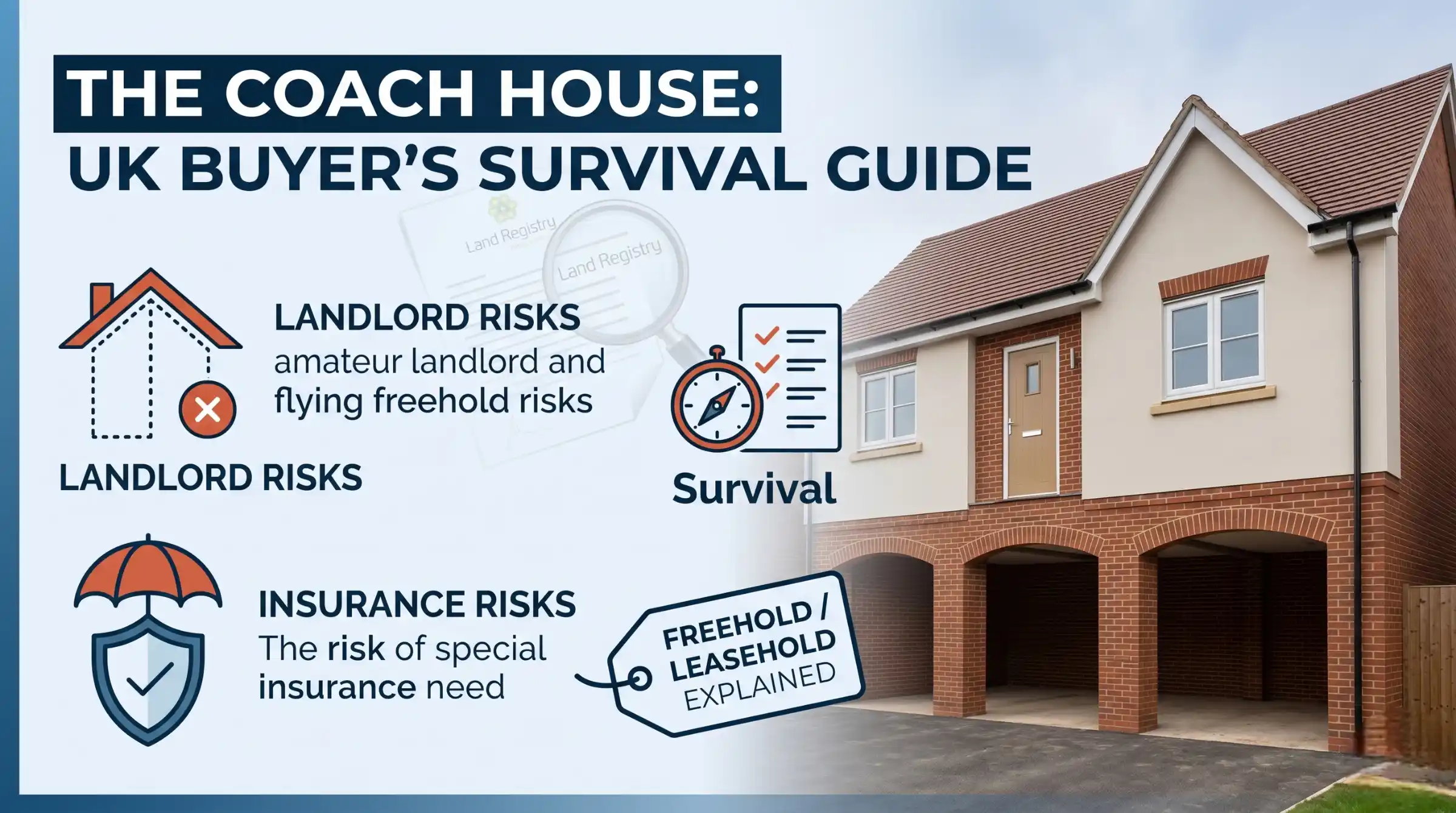
What is a Coach House? The UK Property Buyer’s Legal Survival Guide
It looks like a detached home. But beneath the floorboards lies a web of complex UK property law. While modern estates are full of them, many buyers rush in blind. They simply do not understand the unique hybrid nature of owning a coach house. Before you sign a mortgage deed, you must understand the rules. You need to know about flying freeholds, specialist insurance, and the reality of acting as a freeholder to your neighbours.
A modern UK coach house is a residential property where the primary living space is located on the first floor, situated directly above a row of garages or carports. The coach house owner typically holds the freehold for the entire building, while leasing the underlying garages back to neighbouring properties.
Key Takeaways
- You own the freehold, but neighbours likely hold 999-year peppercorn leases for the garages below.
- Standard home insurance is often invalid. You will need Property Owners’ Legal Liability cover.
- Many coach houses are classed as flying freeholds. This can severely complicate mortgage approvals.
- You are legally responsible for the structural maintenance of the entire building.
- Utility routing must be checked to ensure you aren’t paying for your neighbour’s garage electricity.
Quick Start: The Coach House Conveyancing Checklist
- Check if the property includes a flying freehold over shared land or paths.
- Confirm that all underlying garage leases are set at a peppercorn rent.
- Verify the title deeds contain enforceable positive covenants for structural support.
- Ensure specialist insurance with Property Owners’ Liability is readily available for the plot.
The Modern Definition: What Actually is a Coach House?
Historic Carriage Houses vs. Modern New Builds
Centuries ago, things were simple. Historically, coach houses were 18th and 19th-century outbuildings designed to store horse-drawn carriages on the ground floor with staff quarters above. You can still find these historic carriage house conversions today. For example, you might see a 19th-century estate outbuilding with original arched doorways repurposed into a modern dwelling over a private garage.
Today, developers use them to maximise space. A modern new build coach house is very different. Here, the owner lives on the first floor and holds the freehold. Meanwhile, they lease two or more underlying garages to neighbours on 999-year peppercorn leases. As estate agents note, the owner of the house usually also owns the freehold for the entire building, including the land and the parking spaces below.
The “Amateur Landlord” Trap (The Untold Reality)
Most buyers focus entirely on the benefit of owning the freehold. They miss the hidden catch. You own the building’s structure. But your neighbours are technically your leaseholders.
This makes you an amateur landlord. You must manage relationships, handle shared access dispute resolution, and enforce structural maintenance.
Pro Tip: Always check the legal access rights meticulously. Neighbouring leaseholders may have a protected right of way over your driveway to reach their garages.
Common Mistake: Do not assume the boundary lines are simple. Buyers often fail to consult the HM Land Registry boundaries guide before exchanging contracts, leading to costly driveway disputes later.
Coach House vs. Flat vs. Detached Home: Structural Differences
How does a coach house actually compare to standard properties? It sits in a grey area. It offers the independence of a detached house but the shared structural liabilities of a flat.
Pro Tip: If purchasing on a modern estate, verify if you are liable for supplementary estate management charges alongside the building’s general upkeep.
| Feature | Coach House | Purpose-Built Flat | Detached House |
| Ownership | Freehold (usually) | Leasehold | Freehold |
| Neighbour Proximity | Underneath (garages) | Above, below, and adjacent | None attached |
| Insurance | Specialist (Liability required) | Block/Leasehold policy | Standard Home Insurance |
| Service Charges | Sometimes (Estate fees) | Yes (Maintenance & Ground Rent) | Rarely |
This hybrid structure is exactly why lenders and insurers treat them with caution.
The “Flying Freehold” Complication Explained
What is a flying freehold? It sounds dramatic. In property law, it simply means part of your home overhangs a space you do not own. If your living space extends over a shared pedestrian archway or a neighbour’s property, you have a flying freehold.
This creates a serious structural risk. Under English land law, positive covenants do not automatically bind successors in title. A positive covenant is a legal promise to do something, like maintain a supporting wall. If the original neighbour moves out, the new owner might not be legally bound to fix the wall holding up your living room. Lenders hate this.
Because of these structural risks, UK mortgage lenders apply strict lending criteria. They demand a verifiable scheme of enforceable covenants.
How to Resolve a Flying Freehold for a Mortgage
- Instruct a conveyancer to check the Land Registry title plan immediately.
- Review the deeds for a “deed of covenant” guaranteeing rights of structural support.
- If covenants are absent or defective, arrange flying freehold indemnity insurance.
- Submit proof of this indemnity policy to satisfy the mortgage lender’s criteria.
Mini Case Study: A prospective buyer’s mortgage application is flagged. The coach house deeds lack an enforceable scheme of structural covenants for the garages below. The conveyancing solicitor resolves this by arranging flying freehold indemnity insurance. This satisfies the UK lender’s strict risk criteria, allowing the sale to proceed.
Mid-Article Summary: The Triple Risk of Coach Houses
- Structural Risk: You own the roof and walls, but rely entirely on others for the ground floor.
- Legal Risk: Overhanging properties create flying freeholds, often requiring indemnity policies.
- Financial Risk: Lenders will scrutinize your covenants heavily before approving a mortgage.
Specialist Coach House Insurance: Why Standard Policies Fail
Standard home insurance is virtually useless for a coach house. Why? Because of the complex legal liabilities attached to the leasehold garages sitting beneath your living space.
As experts warn: “A standard detached or semi-detached buildings insurance policy will not provide the correct cover and not all mainstream insurers understand what a coach house is.”
You need specialist cover. Specifically, your policy must explicitly include Property Owners’ Legal Liability. This protects you, the freeholder, against claims originating from the leaseholders using the ground-floor garages.
Mini Case Study: A coach house freeholder experiences a severe water leak. It damages a neighbour’s expensive vehicle parked in the leased garage below. A standard home insurance policy denies the claim. However, a specialist coach house policy with Property Owners’ Legal Liability successfully pays out for the neighbour’s damages.
“It is your insurance responsibility to find the right home insurance that will cover the freehold top floor and leasehold garages.”
Insurance Eligibility Decision Tree
-
Do you own the freehold for the entire building?
-
If Yes, proceed. If No, seek standard leasehold flat insurance.
-
- Are there garages underneath leased to third parties?
-
If Yes, standard home insurance is invalid.
-
- Does the proposed policy include Property Owners’ Legal Liability?
-
-
If Yes, the policy is suitable. If No, reject the policy.
-
Pro Tip: Do not rely on standard comparison sites. Use the FCA Financial Services Register to find an authorized insurance broker who specializes in non-standard property types.
The Pros and Cons of Living in a Coach House
The Advantages of Coach Houses
- Zero Residential Neighbours: You have no upstairs or downstairs residential neighbours. This drastically reduces impact noise.
- Detached Feel: They offer the privacy of a detached home but often at a much lower asking price.
- Private Parking: They almost always include your own private garage and driveway space.
The Drawbacks and Hidden Costs
- Heating Issues: Coach houses are notoriously cold. Living spaces situated directly above unheated garages lose heat fast.
- Utility Disputes: You must confirm whether utility supplies for the leased garages run off your residential meters. You do not want to subsidise a neighbour’s energy usage.
- Remortgaging Delays: Without proper paperwork and indemnity insurance, refinancing can be incredibly slow.
Pro Tip: Assess the EPC (Energy Performance Certificate) carefully. Living above an unheated void often requires upgraded floor insulation to keep energy bills down.
Summary
A coach house offers fantastic privacy and freehold ownership. But it is not a standard property. The dual nature of being a freeholder to leasehold garages demands rigorous conveyancing, specialist insurance, and a clear understanding of flying freeholds to protect your investment.
Next Steps:
- Download the title plan for your prospective property from the Land Registry.
- Speak to a specialist UK insurance broker regarding Property Owners’ Liability.
- Instruct a conveyancing solicitor highly experienced in flying freeholds.
FAQs
Are coach houses hard to sell in the UK?
They can take longer to sell if the legal paperwork is messy. If your indemnity insurance and deed of covenants are in perfect order, they sell just as quickly as flats or terraced homes.
Do I have to pay ground rent on a coach house?
Usually, no. You own the freehold. Instead, your neighbours pay you rent for the garages, which is almost always a “peppercorn rent” (a nominal, non-collected fee).
Are coach houses notoriously cold?
They can be. Because the floor sits directly over unheated garages, poor floor insulation can lead to a cold property and higher heating bills.
Can I convert the leasehold garages underneath my coach house?
No. You own the freehold of the building, but you have leased that space to a neighbour for 999 years. You cannot convert space you have legally leased out.
What happens if the leaseholder damages the garage?
This is why you need Property Owners’ Legal Liability insurance. It covers legal costs and damages if disputes arise regarding the structural fabric of the leased garage.
Do you pay service charges on a freehold coach house?
You don’t pay standard leasehold service charges. However, if the coach house is on a modern private development, you will likely pay estate management charges for road and lighting upkeep.
Is a coach house better than a flat?
Many buyers prefer them. You own the freehold, have no shared hallways, and suffer no noise from upstairs neighbours. However, the legal responsibilities are much higher than owning a leasehold flat.
What does ‘peppercorn lease’ mean for coach house garages?
It means the garage is leased for a completely nominal amount (historically an actual peppercorn) to make the legal contract binding, meaning no real money changes hands.
About the Author