HMRC Wage Raid: 2026 Payroll Changes That Could Bankrupt You
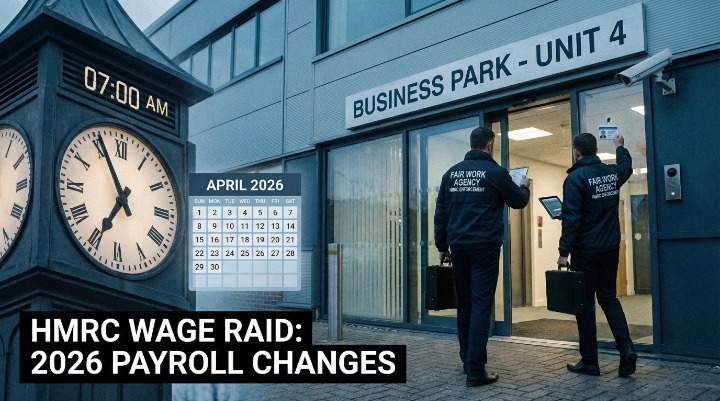
It starts with a simple letter or, in worse cases, a knock on your warehouse door at 9:00 AM. A team of inspectors asks to see your payroll records, your time-tracking software, and your shift rotas. They don’t want estimates. They want exact data.
This is what the media calls an hmrc wage raid payroll checks operation. But in 2026, the game has changed.
For years, many UK business owners treated payroll compliance as a once-a-year administrative chore. That attitude is now dangerous. With the launch of the Fair Work Agency (FWA) and the April 2026 shift to mandatory benefits reporting, the government has handed enforcement officers unprecedented power.
If you are a director or HR manager in a high-risk sector like hospitality, retail, or construction, you need to understand the new rules of engagement. This guide explains exactly why HMRC is targeting you and how to audit your systems before they arrive.
What is an HMRC “Wage Raid” in 2026?
The term “wage raid” is industry shorthand for an Employer Compliance Check. Historically, these were conducted by separate bodies: HMRC handled the National Minimum Wage (NMW), while the Gangmasters and Labour Abuse Authority (GLAA) handled exploitation.
That separation is gone.
From HMRC to the Fair Work Agency (FWA)
[GOV.UK Labour Market Enforcement Strategy 2025/26]
The biggest shift in 2026 is the consolidation of enforcement. The new Fair Work Agency acts as a “super-regulator,” merging the powers of HMRC’s NMW team, the GLAA, and the Employment Agency Standards Inspectorate.
Why does this matter to you?
Previously, an inspector might only look for tax errors. Now, a single visit can trigger investigations into:
-
NMW underpayment.
-
Holiday pay calculation errors.
-
Modern slavery risks in your supply chain.
-
Agency worker regulation breaches.
They share data instantly. If your RTI submission looks inconsistent, the FWA knows before they even enter your building.
The New £12.71 National Living Wage Trigger
The National Living Wage (NLW) rose to £12.71 per hour in April 2026. This increase didn’t just raise your wage bill; it effectively removed the “safety buffer” many employers relied on.
The “Accidental” Underpayment Trap:
Many employers believe they pay above the minimum wage because their base rate is £13.00. However, common deductions can drag that rate below the legal floor.
My Experience: I recently audited a logistics firm that paid drivers £13.50 an hour. They felt safe. But they required drivers to buy a £50 branded jacket from their first pay packet. That single deduction dropped the effective hourly rate below £12.71 for that pay period. result? A technical breach for every single new starter. The FWA treats this as NMW arrears, subject to 200% penalties.
The 2026 “Compliance Trap”: Mandatory Payrolling of Benefits
For decades, employers filed P11D forms months after the tax year ended. As of April 2026, that system is dead. You must now report benefits in kind (company cars, health insurance) via Real Time Information (RTI) every time you run payroll.
This shift has created a massive new trigger for hmrc wage raid payroll checks.
Why This Triggers Audits
If your Full Payment Submission (FPS) data does not match the benefits contracts HMRC holds on file, their Connect AI system flags a discrepancy. You no longer have a “clean-up period” at year-end to fix mistakes.
Pro-Tip: Watch Out for the “Double Tax” Hit
When you switch to payrolling benefits, employees will pay tax on their benefits in real-time, effectively reducing their monthly take-home pay compared to the previous year (where tax was often collected via code adjustments later).
Action: Communicate this to staff before they see their payslip. If you don’t, you will face a revolt from the workforce, and disgruntled employees are the number one source of anonymous tip-offs to the FWA.
Joint and Several Liability: Is Your Umbrella Company a Risk?
This is the sleeper rule that will catch out thousands of UK directors in 2026.
If you use recruitment agencies or umbrella companies to source temporary labour, you are now at risk. Under the new Joint and Several Liability provisions, if your supply chain creates tax losses (e.g., through Mini Umbrella Company fraud or disguised remuneration schemes), HMRC can recover that unpaid tax from you, the end client.
The Red Flag Checklist
Do not accept a simple “we are compliant” certificate from an agency. You need to dig deeper.
-
Check the Companies House History: Has the umbrella company director resigned from 10 other dissolved companies in the last year?
-
Verify the Payslips: Ask your agency workers to show you a payslip. If you see “loan payments,” “grants,” or “capital advances” instead of taxable salary, stop using that provider immediately.
-
The “Too Good to Be True” Rate: If an agency offers you labour at a rate that barely covers the £12.71 NLW plus employer NI, they are evading tax. You will be left holding the bill.
Inside a Workplace Visit: What Actually Happens?
Fear comes from the unknown. Let’s remove that fear by walking through a standard inspection.
The Inspector’s Powers
FWA officers have the right to:
-
Enter your business premises at any reasonable time.
-
Interview you and your staff (sometimes privately).
-
Access and copy any records related to pay, hours, and contracts.
They do not need a warrant to enter and inspect documents, but they do need one to seize items or search your home.
Your First 30 Minutes Action Plan
If inspectors arrive, stay calm and follow this protocol:
-
Verify Identity: Ask to see their warrant card. Note down their name and ID number.
-
Request a Delay: You have the right to ask for time to gather records or have your accountant present. They usually grant a short window (e.g., 2 hours or rescheduling for the next day if key staff are absent).
-
Designate a Room: Put them in a meeting room away from the main floor. Do not let them wander freely and “chat” to staff unsupervised until formally arranged.
-
Do Not Volunteer Extra Info: Answer the specific question asked. Do not speculate or guess. “I will check the records and confirm” is a perfectly valid answer.
How to Prepare: Your 2026 Payroll Audit Checklist
You cannot rely on software alone. Software calculates what you tell it to; it cannot tell if your data input is legally compliant.
Run this internal audit before April comes around.
| Record Type | Retention Period | High-Risk Check |
| Time Records | 6 Years | Are you recording “security checks” or “changing time” as working hours? |
| Deductions | 6 Years | Do uniform or tool deductions take pay below £12.71/hr? |
| Worker Status | Indefinite | Are “self-employed” contractors actually disguised employees? |
| Right to Work | Duration of employment + 2 years | Do you have valid digital share codes for all non-UK nationals? |
[ACAS Guide to Working Time Regulations 2026]
Summary
The days of lenient HMRC enforcement are over. The 2026 landscape is defined by data connectivity and the aggressive mandate of the Fair Work Agency. An hmrc wage raid payroll checks operation is no longer just about catching tax evaders; it is about policing the granular details of the £12.71 National Living Wage and real-time reporting.
Compliance is not a passive activity. It requires you to look at your business through the eyes of an inspector. Do your contracts match your working reality? Are your agencies legitimate?
If you are unsure, do not wait for the knock on the door. Audit your systems now.
FAQs
Can HMRC turn up unannounced for a payroll check?
Yes. While they often give 7 days’ notice for routine checks, the new Fair Work Agency has powers to conduct unannounced visits if they suspect NMW breaches or modern slavery risks.
What is the penalty for NMW underpayment in 2026?
The penalty is 200% of the total underpayment owed, capped at £20,000 per worker. You will also be publicly named on the government’s “Naming and Shaming” list, which poses a severe reputational risk.
Do I still need to file a P11D in 2026?
No. From April 2026, the P11D form has been effectively scrapped for most benefits. You must report benefits like health insurance and company cars via RTI (payroll software) each pay period.
What is the Fair Work Agency?
The Fair Work Agency (FWA) is the UK’s new single enforcement body launched to uphold employment rights. It combines the powers of HMRC NMW enforcement, the Gangmasters and Labour Abuse Authority (GLAA), and the Employment Agency Standards Inspectorate.
How far back can an HMRC payroll check go?
Standard checks usually cover the last 6 years. However, if they suspect deliberate fraud or negligence, they can investigate up to 20 years of records.
Can I be held liable for my recruitment agency’s tax errors?
Yes. Under the 2026 Joint and Several Liability rules, if your supply chain (e.g., an umbrella company) fails to pay the correct tax/NICs, HMRC can transfer that debt to you as the end client.
Does the £12.71 rate apply to all ages?
The £12.71 National Living Wage applies to workers aged 21 and over. There are lower rates for those aged 18-20 and apprentices, but you must strictly monitor birthdays to ensure you upgrade their pay immediately upon turning 21.
About the Author