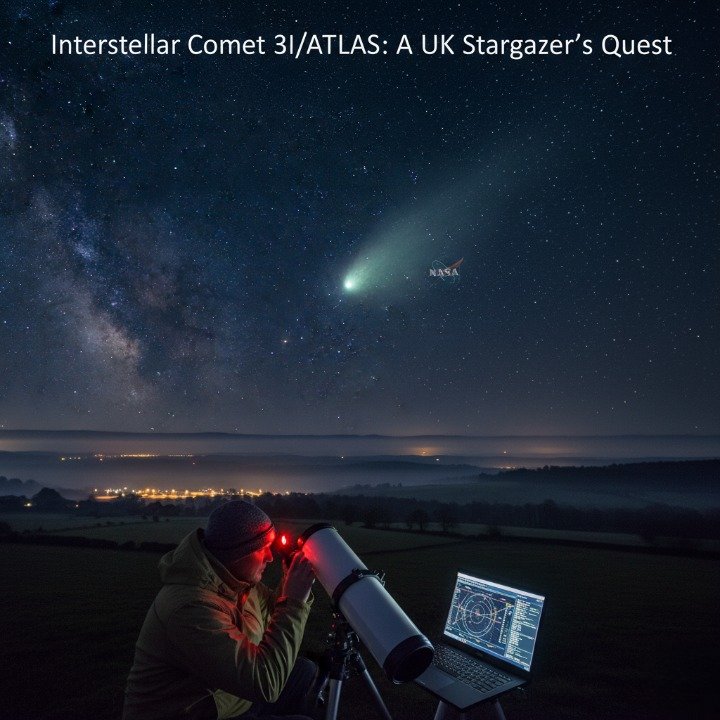
Interstellar Comet 3I/ATLAS: NASA Baffled? A UK Stargazer’s Guide
A third mysterious visitor from outside our solar system has arrived, and it’s “breaking the rules.” Interstellar Comet 3I/ATLAS is accelerating in a way scientists can’t perfectly explain, sparking a major debate: Is it a natural phenomenon, or something else?
Following in the footsteps of 1I/’Oumuamua and 2I/Borisov, 3I/ATLAS is only the third object ever confirmed by the International Astronomical Union (IAU) to have come from the vast emptiness of interstellar space.
This article cuts through the hype. We’ll dive into what interstellar comet 3I/ATLAS NASA teams, using the James Webb Space Telescope (JWST) and Hubble, are actually seeing. We’ll break down the “controversy” in simple terms, and—most importantly—provide a practical, hands-on guide for how to see 3I/ATLAS from the UK.
What Is Interstellar Comet 3I/ATLAS?
A Visitor from Another Star: 3I’s Discovery and Hyperbolic Orbit
On July 1, 2025, the NASA-funded ATLAS survey (Asteroid Terrestrial-impact Last Alert System) in Hawaii picked up a faint, fast-moving object. Astronomers quickly realized this was no ordinary comet.
The IAU Minor Planet Center (MPC) officially designated it 3I/ATLAS, confirming it as the third known interstellar object (ISO).
Its origin was proven by its path. According to the MPC, 3I/ATLAS has an extreme hyperbolic orbit with an eccentricity of 6.139. In simple terms, it’s moving so fast (over 20 miles per second relative to the Sun) that it’s not “caught” by our sun’s gravity. It’s on a path to swing by our sun (reaching its closest point, or perihelion, on October 29, 2025) and fly right back out into deep space, never to return.
How Does 3I/ATLAS Compare to ‘Oumuamua and Borisov?
This is our third interstellar visitor, but it’s proving to be just as unique as the first two. Here’s how they stack up.
The Big Mystery: Why Is 3I/ATLAS “Accelerating”?
This is the heart of the debate. Like ‘Oumuamua before it, 3I/ATLAS is not moving exactly as gravity alone dictates. It has a tiny, extra “push,” known as non-gravitational acceleration.
What Is “Non-Gravitational Acceleration”?
Imagine a car rolling downhill. That’s gravity. Now, imagine that car also has a tiny, sputtering engine giving it an extra, almost imperceptible push. Scientists can see that extra push on 3I/ATLAS, but they are debating what’s causing the “sputter.”
Theory 1: Professor Avi Loeb and the “Alien Tech” Hypothesis
Harvard astronomer Avi Loeb, who famously suggested ‘Oumuamua could be an alien probe, has raised similar questions about 3I/ATLAS.
In his analysis, he argues that the “push” is too strong to be explained by natural causes without the comet losing an impossibly large amount of its mass. In a paper posted to his Medium page, Loeb suggests that to get this much acceleration from the “rocket effect,” the comet would have to lose over 13% of its entire mass during its brief pass, which he deems “unlikely.”
His provocative conclusion is that we cannot rule out an artificial origin—in other words, an engine.
Theory 2: NASA & ESA’s “Rocket Effect” from Outgassing (The Expert Consensus)
The overwhelming scientific consensus, supported by NASA and the European Space Agency (ESA), points to a much more natural (but still fascinating) explanation.
This “extra push” is a well-known cometary phenomenon called the “rocket effect.”
As the comet gets closer to the sun, its ices heat up and turn directly into gas—a process called sublimation. These gases, like water vapor and carbon dioxide, shoot out in jets. Just like a thruster on a spacecraft, these jets push the comet in the opposite direction, causing the “non-gravitational acceleration.”
Most scientists believe the “push” seen on 3I/ATLAS is simply a more extreme version of this. Its unique composition (which we’ll get to next) likely causes it to outgas in a more powerful or unusual way than the comets from our own solar system.
What NASA’s Telescopes Have Actually Seen (JWST & Hubble)
While the debate rages, NASA’s most powerful tools, including the James Webb Space Telescope (JWST) and Hubble Space Telescope, have been gathering hard data on this interstellar comet 3I/ATLAS NASA has been studying.
The “Glowing Green” (Diatomic Carbon) and “Bluer than the Sun” Composition
Observations from NASA’s Infrared Telescope Facility (IRTF) and JWST show 3I/ATLAS has a very unusual chemical makeup.
It is “bluer than the sun,” which points to a very high ratio of carbon dioxide (CO2) to water (H2O) ice. It’s also “glowing green,” a classic sign of diatomic carbon (C2) being vaporized by solar radiation. This isn’t unusual for comets, but the intensity and ratios of these chemicals are different from what we typically see.
The “Tailless” Comet: Why Is 3I/ATLAS Missing Its Tail?
One of the most confusing traits for early observers was its “missing” tail. Despite being a comet and actively outgassing, it lacks the bright, dusty tail we associate with objects like Hale-Bopp or Halley’s Comet.
Scientists at NASA and The Planetary Society suggest this isn’t a mystery, but a clue. It tells us that 3I/ATLAS is likely not rich in the fine dust that creates bright, reflective tails. Its “rocket effect” is likely being driven by jets of gas (like CO2) rather than a mix of gas and dust. This shows it was likely formed in a very different type of solar system than our own.
A Practical Guide: How to See Comet 3I/ATLAS from the UK
This is the big question for all UK-based amateur astronomers. Can you see it? The short answer is yes, but it is extremely challenging.
First, Let’s Manage Expectations (It’s Not Easy)
This is not a “Hollywood” comet. You will not see a bright streak with the naked eye. From the UK in mid-November 2025, 3I/ATLAS is a very faint, diffuse “fuzzball.”
It’s what astronomers call a “Telescope-Only Object.” And even then, it will be a difficult “find” from light-polluted areas. This is a challenge for dedicated observers, not a casual glance. But for those willing to try, finding it is the real victory.
Your 5-Step UK Observation Plan (An Astronomer’s Log)
As a UK-based astronomy enthusiast, this is my personal checklist for attempting to spot 3I/ATLAS in mid-November.
A UK Observer’s Log: My 5-Step Plan to Find 3I/ATLAS
- Gear Check: I’m using my 8-inch telescope at a minimum. This object is faint (around 9th or 10th magnitude), so aperture is everything. This is not a binocular object from a UK city.
- App Update: I am not using a standard star app. Because of its non-gravitational acceleration, its path is not perfectly predictable. I’m downloading the latest orbital elements (“ephemeris”) from the Minor Planet Center and importing them into my guide software (like SkySafari Pro or Stellarium) right before I go out.
- Location & Timing: It’s low in the predawn eastern sky. For me (near London), that means I need a clear view, free of houses and trees, from about 4:30 AM to 5:30 AM.
- Technique: I won’t be looking directly at its position. I’ll be using “averted vision”—looking slightly to the side of where my map says it is. This lets my eye’s more sensitive rods pick up the faint, diffuse smudge.
- Managing Expectations: I’m not looking for a tail or a bright point of light. I’m looking for a tiny, ghostly, out-of-focus “fuzz” that shouldn’t be there. Just finding that smudge will be the victory.
Common UK Pitfalls (and How to Avoid Them)
- Mistake #1: Underestimating Light Pollution. This is the biggest UK-specific challenge. The comet’s “bluish-green” tint is especially hard to see against the “sodium-orange” glow of UK city lights. You must get to the darkest site you can find.
- Mistake #2: Using the Wrong Map. I’ll say it again: an old star chart or a non-updated app will not work. Its path is changing daily. You need live MPC data.
- Mistake #3: Forgetting the Moon. Always check the moon phase! The best time to hunt for faint objects is during the two weeks around the New Moon. A bright moon will make this comet completely invisible.
What’s Next for 3I/ATLAS? (And Is It Dangerous?)
Is Comet 3I/ATLAS Going to Hit Earth?
Let’s be perfectly clear: No. Not even close.
Interstellar Comet 3I/ATLAS poses zero threat to Earth. The Minor Planet Center has confirmed its trajectory. Its closest approach to our planet will be on December 19, 2025, at a very safe distance of 1.8 AU.
An “AU” (Astronomical Unit) is the distance from the Earth to the Sun. So, at its closest, 3I/ATLAS will still be 1.8 times further from us than the sun is—about 170 million miles away.
A Future Rendezvous: ESA’s JUICE Mission Flyby
While NASA studies it from afar, the European Space Agency (ESA) has an exciting encounter planned.
By a remarkable coincidence of orbital mechanics, ESA’s JUICE spacecraft (JUpiter ICy moons Explorer) is on a trajectory that will take it very close to 3I/ATLAS. In February 2026, JUICE is scheduled to perform a flyby of the comet, giving us our first-ever close-up images and data from a confirmed interstellar object. This encounter will be a monumental event in planetary science.
Our Interstellar Visitor: What We Know and What We’re Learning
In just a few short months, 3I/ATLAS has gone from a faint blip to a global scientific mystery. We know it’s the third interstellar object ever confirmed. We know its “non-gravitational” acceleration is most likely caused by natural outgassing (per NASA), not aliens. And we know it’s a very challenging, but possible, target for dedicated UK observers.
This comet isn’t just a “thing.” It’s a free sample from another solar system. The debates, the JWST observations, and even the attempts from our own backyards are the real-time process of science, helping us understand our place in the galaxy.
What are your theories on 3I/ATLAS? Are you planning to observe it from the UK? Share your own observer’s log or questions in the comments below.
FAQs
Is Interstellar Comet 3I/ATLAS going to hit Earth?
No. Comet 3I/ATLAS is not dangerous and poses zero threat. Its closest approach to Earth is on December 19, 2025, at a very safe distance of 170 million miles (1.8 AU).
Why is Comet 3I/ATLAS so controversial?
The controversy comes from its “non-gravitational acceleration.” The scientific consensus (NASA, ESA) is that this is caused by natural “outgassing.” A minority view, championed by astronomer Avi Loeb, suggests its acceleration is hard to explain naturally and that an artificial (alien) origin can’t be ruled out.
What is “non-gravitational acceleration” in a comet?
It’s an “extra push” on the comet not caused by gravity. As ices on the comet’s surface turn to gas (sublimate), they shoot out as jets. These jets act like tiny rocket engines, pushing the comet slightly off its purely gravitational path.
What’s the difference between 3I/ATLAS, ‘Oumuamua, and Borisov?
‘Oumuamua (1I) was rocky and cigar-shaped. Borisov (2I) was a “normal” comet, very similar to our own. 3I/ATLAS is a “weird” comet: it’s accelerating, has an unusual “bluish-green” color, and appears to be “tailless.”
Can I see 3I/ATLAS with binoculars from the UK?
It is highly unlikely. From the UK, this is an extremely faint object (9th-10th magnitude). It is considered a “telescope-only” object, requiring at least an 8-inch telescope and very dark, clear skies.
What is NASA’s official explanation for 3I/ATLAS’s acceleration?
NASA’s explanation, which is the scientific consensus, is that the acceleration is caused by the “rocket effect” of sublimation. As ices (like CO2) on the comet’s surface are heated by the sun, they turn to gas and shoot out, pushing the comet.
Why is Comet 3I/ATLAS glowing green but has no tail?
The “glowing green” comes from diatomic carbon (C2) gas in its coma (the atmosphere around the comet’s nucleus) being lit by the sun. It appears “tailless” because it is likely “gassy” but not “dusty.” The bright, reflective tails we usually see are made of fine dust, which 3I/ATLAS seems to lack.
When is the best time to see 3I/ATLAS from the UK?
The best time in mid-November 2025 is in the predawn sky (around 4:30 AM – 5:30 AM), low on the eastern horizon. You must choose a night with no moon (near the New Moon) and get to a location far from city light pollution.
About the Author